
Chinese Seal vs Japanese Hanko: What's the Difference?
Short answer: Japanese hanko, also called inkan, descend from Chinese seals, but the two have drifted apart: Chinese art seals are usually square soft-stone blocks carved in seal script, while Japanese personal seals are usually small round cylinders. In Japan, personal seals are still part of everyday paperwork, with a registered jitsuin for major contracts, a bank seal and an everyday mitomein. In mainland China, seals matter most for companies, while personal name seals are mainly artistic or sentimental.
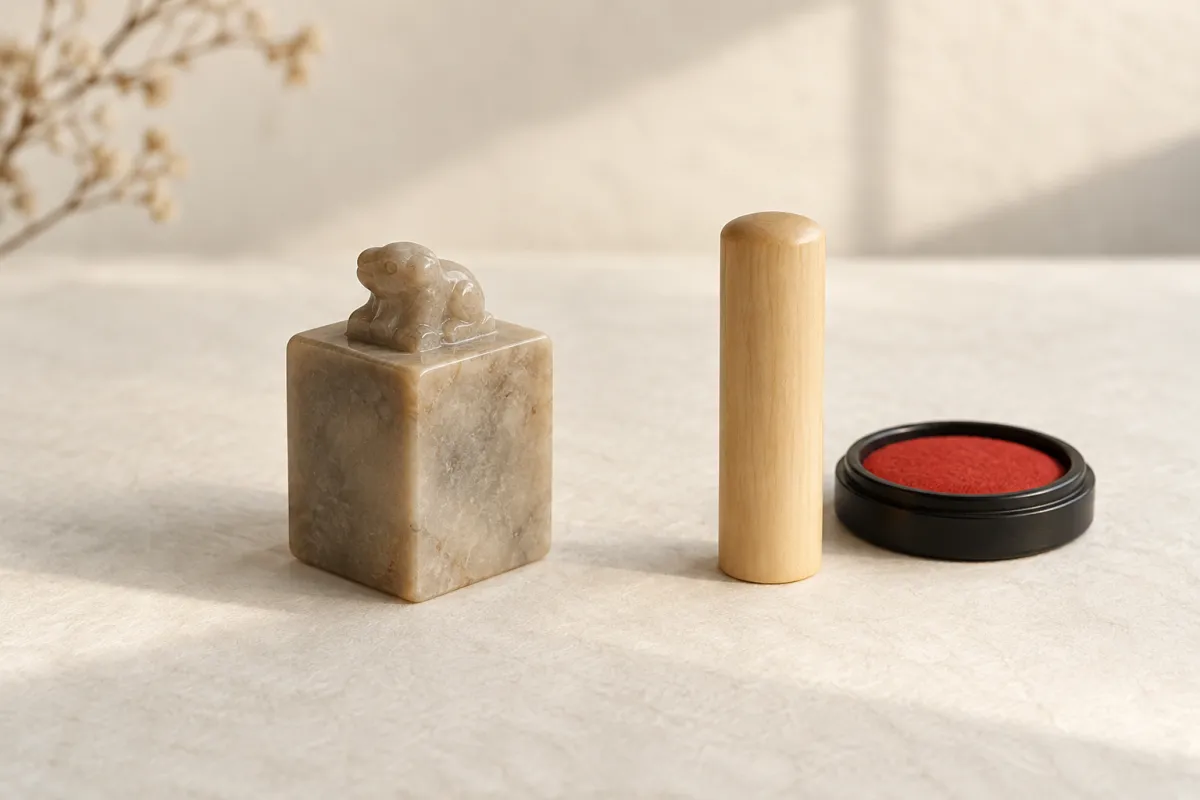
Chinese seals and Japanese hanko look like close cousins, and they are. Both are carved blocks that print a name in red, and both come from the same ancient tradition. But in daily life they now do very different jobs. Below is how they are related, how each is used today and how to tell them apart.
A shared origin
Seals reached Japan from China. Japan’s oldest known seal is a small gold seal that, according to Chinese records, a Han-dynasty emperor gave to an envoy from Japan in 57 CE. It was dug up in Kyushu in 1784. In 701, a decree standardized official seals in Japan. Personal seals spread widely after an early Meiji-era law set up a national system for registering and certifying them.
The vocabulary is shared too. Chinese speakers call a seal 印章 (yìnzhāng). Japanese speakers usually say hanko (判子), for the seal itself, or inkan (印鑑), which strictly means the impression a seal leaves but is often used for the seal itself. Both languages write “seal” with the same character, 印.
Japan’s three everyday seals
Many adults in Japan keep three personal seals:
- Jitsuin (実印), the registered seal. It is registered at the local city or ward office and used for major transactions such as buying property or a car, taking out a loan or making a will. Each person can register only one. Residents over 15 can register, including foreign residents, and the name must match the resident record. Once it is registered, you can request a certificate of the seal’s impression (印鑑登録証明書, inkan tōroku shōmeisho) to attach to contracts. Registered impressions generally must measure between 8 and 25 mm.
- Ginkōin (銀行印), the bank seal. It is registered with a bank when you open an account, and each bank sets its own rules.
- Mitomein (認印), the everyday seal. It is unregistered and used for routine things like signing for deliveries or initialing internal memos. Cheap ready-made versions, often carved with just the family name, are sold everywhere.
Self-inking rubber stamps, often called by the brand name Shachihata, are fine for informal use. They can’t be registered as a jitsuin, because their rubber faces can change shape. Artists also use seals much as Chinese artists do, including art-name seals (雅号印, gagōin) stamped on paintings and calligraphy.
Japan’s move away from hanko
In 2020, as the pandemic pushed people to work from home, Japanese media reported on employees who had to go into the office just to stamp paperwork, and the custom came under heavy criticism. Taro Kono, then minister for administrative reform, told ministries to drop seals from administrative procedures in principle. On November 13, 2020, a Cabinet Office official said seal requirements would be removed from nearly 15,000 administrative procedures, keeping them in only 83 cases such as automobile registration, according to Reuters.
That change covered government procedures, not private life. Registered seals are still used for property, inheritance and other important transactions.
Seals in China today
In mainland China, legal seals are mainly organizational. A company’s official seal (公章, gōngzhāng) must be filed with the Public Security Bureau and takes the place of a signature on important documents. Companies often hold separate seals for finance, contracts, invoices and customs, plus a personal seal for the legal representative named on the business license. Under China’s Electronic Signature Law, electronic seals that meet set security conditions have the same legal standing as physical ones. Seals of government bodies are typically round, with a five-pointed star in the center.
For individuals on the mainland, personal seals play a much smaller role than in Japan. They survive in some banking uses, among artists, calligraphers and collectors, and as gifts and keepsakes. Taiwan is different. Its household registration offices still run a registered-seal system (印鑑登記, yìnjiàn dēngjì). A registered seal must use the name on the household register and measure between 1 and 3 cm, and rubber or other easily deformed materials are not allowed.
Side by side
| Chinese seal (art and personal) | Japanese hanko (personal) | |
|---|---|---|
| Typical shape | Square block; also round, oval or free-form | Small round cylinder, about 1–2 cm across |
| Typical script | Seal script, sometimes other scripts | Seal-derived styles such as tensho (篆書体) and insōtai (印相体), or koin-tai (古印体), a Japanese style; katakana or Roman letters possible |
| Typical text | Full name, style name, studio name or a phrase | Family name, given name or full name |
| Typical materials | Soft stones (Shoushan, Qingtian, Changhua, Balin), also jade, metal, wood | Boxwood, water buffalo horn, titanium and others |
| Ink | Cinnabar seal paste (印泥, yìnní) | Red pad or paste (朱肉, shuniku), or a self-inking stamp |
| Legal role | Company seals are legally central; personal seals mostly artistic (registered in Taiwan) | A registered jitsuin works like a legal signature |
On scripts, Japanese registered seals favor stylized forms. Japanese Wikipedia notes that tensho has been widely used for personal and corporate registered seals and bank seals since the Shōwa era, and that insōtai, whose characters touch the border, is popular for personal registered seals. Chinese art seals use seal script mainly for its history and beauty. Our seal script guide explains why.
Which one do you need?
If you live in Japan and need to register a seal for banking or contracts, go to a local hanko shop. The rules on size, name and material are set by your city office and your bank. If you want a seal for art, letters, books or a meaningful gift, the Chinese tradition offers more room for design: square or round, white or red characters, and a stone you’ll enjoy holding.
Chop1’s free online studio gives you a Chinese name and a digital seal you can download as a PNG. A custom seal can be made in any of the four famous seal stones or in crystal, jade or gold; Shoushan seals start at US$299 including express shipping; other materials are quoted. It is a keepsake, not a registered seal or a legal signature in Japan, China or anywhere else.
Questions
Is a hanko the same as a Chinese chop?
They share an origin but not a job. Hanko come from the Chinese seal tradition, but in Japan a registered personal seal still works like a legal signature for contracts and banking. In mainland China, legal seals are mainly company seals, and personal name seals are mostly used in art or as keepsakes.
What are jitsuin, ginkōin and mitomein?
They are Japan’s three common personal seals. The jitsuin is registered at the city or ward office and used for major transactions such as property, cars, loans and wills. The ginkōin is registered with a bank. The mitomein is an unregistered everyday seal for things like signing for deliveries.
Is Japan getting rid of hanko?
Partly. In November 2020 the government said it would drop seal requirements from nearly 15,000 administrative procedures, keeping them in 83 cases such as car registration. Registered seals are still used for important private and legal transactions.
Can a foreigner register a hanko in Japan?
Yes. Foreign residents who are legally living in Japan and over 15 can register a seal as a jitsuin at their municipal office. The name on the seal must match the name on their resident record, and the seal can be in kanji, katakana or Roman letters.
Sources
- Hanko and Inkan: Japanese Stamps and Personal Seals (Nippon.com)
- Japan to scrap centuries-old custom of stamping paperwork (Reuters, via Free Malaysia Today)
- 印章 (Japanese Wikipedia)
- Seal (East Asia) (Wikipedia)
- Company Chops in China: What Are They and How to Use Them (China Briefing)
- 印鑑登記 Q&A (Department of Household Registration, Ministry of the Interior, Taiwan)