
What Is a Chinese Chop? Meaning, History and Uses
Short answer: A Chinese chop is a seal, 印章 (yìnzhāng): a small block of stone, metal or another material carved with a name or phrase and stamped in red paste. The English word “chop” comes from Hindi chāp, “stamp,” and was carried by traders from India to the China coast. Today seals serve as companies’ official marks, as artists’ signatures on their work and as personal keepsakes.
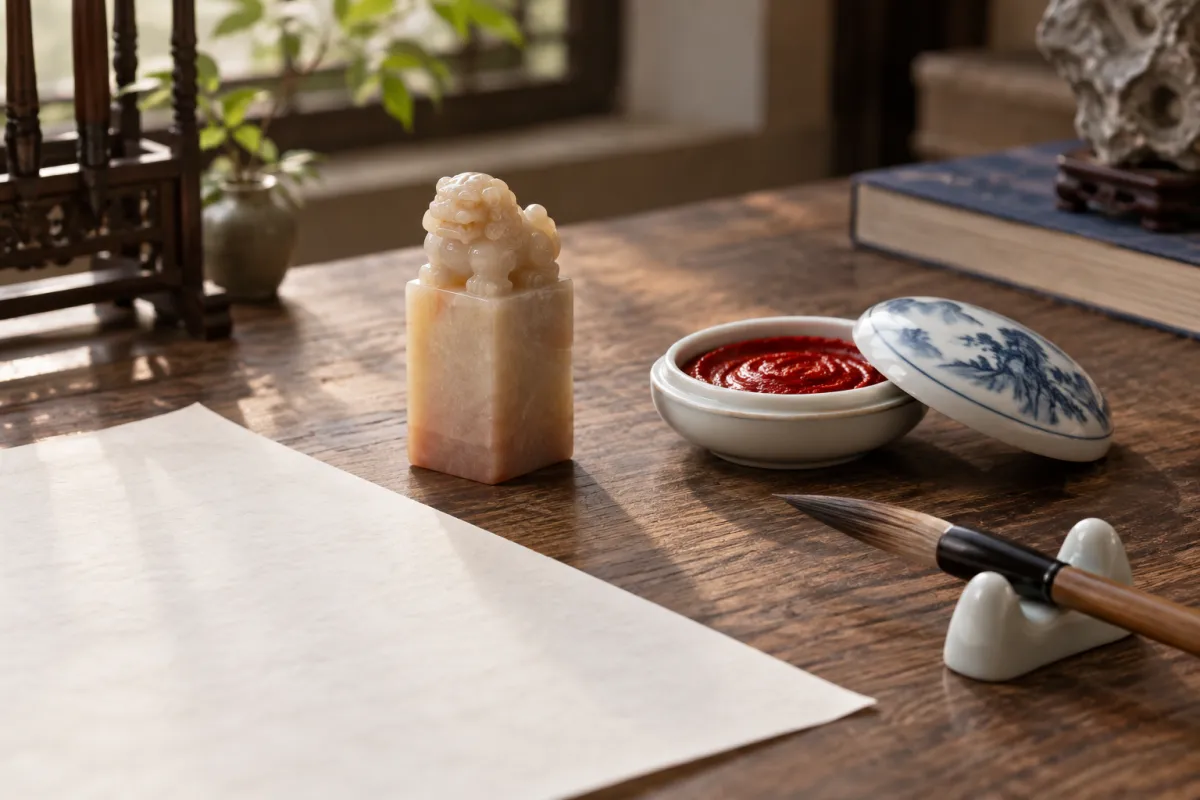
Chinese seals have been in use for well over two thousand years. They have been badges of office, tools of trade and the finishing touch on paintings, and in China they are still part of business life today. English speakers often call them “chops.” This guide explains what a seal is, where that odd English word came from, how seals developed and how people use them now.
What a chop is
A seal is a small block, most often square, with characters carved into one end, the seal face (印面, yìnmiàn). The characters are cut in mirror image. You press the face into red seal paste (印泥, yìnní), then onto paper, and the characters print the right way round. Chinese speakers usually say 印章 (yìnzhāng), 图章 (túzhāng) or simply 章 (zhāng). Nobody in China calls it a chop.
The text on a seal depends on what it is for:
- Name seals carry a person’s name. They are the most common personal seals.
- Style-name and studio seals carry a courtesy name, an art name or the name of the owner’s studio.
- Leisure seals (闲章, xiánzhāng) carry a short phrase, a line of poetry or a motto the owner likes.
- Collectors’ seals (收藏印, shōucángyìn) record that someone owned or viewed a work of art.
- Official seals belong to an office or an organization rather than a person.
Most traditional seals are carved in seal script, an ancient style of Chinese writing; our guide to seal script explains why. Characters can print white on red or red on white, which is the difference between yin and yang seals.
Why English says “chop”
The word came into English in India. Hindi chāp (also written chhāp) means a stamp, print or impression. English speakers there used it for seals and official stamps. In Southeast Asia, the related Malay word cap helped keep it alive, and traders carried it to the China coast.
In the China trade, “chop” stretched to cover the seal itself, a permit or document validated by a seal, and the brand mark on goods such as tea and silk. Dictionaries still give examples like “silk of the first chop.” From that sense of grade or brand came the colloquial phrase “first chop,” meaning first-rate, which turns up in 19th-century English. So when someone calls a Chinese seal a chop, they are using a word with Indian roots that was shaped by trade on the China coast.
A short history
Bronze, jade and clay
The oldest objects identified as Chinese seals are small bronzes linked to the Shang-dynasty site at Anyang, though scholars still debate how they were used. By the Spring and Autumn and Warring States periods (770–221 BCE), seals were common, and every seal, official or private, was called a 玺 (xǐ).
After the Qin unified China in 221 BCE, xǐ was reserved for the emperor’s seals, and everyone else’s seal was a 印 (yìn). Officials received seals as the badge of their office and rank. In the Han dynasty, seals were pressed into lumps of clay (封泥, fēngní) that secured bundles of documents. Once paper became common, seals were inked and stamped straight onto the page, and red cinnabar paste became standard.
Scholars take up the knife
Song and Yuan scholars took a growing interest in seals, but bronze, jade and ivory were hard to cut, and the carving was usually left to craftsmen. That changed in the Ming dynasty, when soft stones came into wide use. As a recent Hong Kong University of Science and Technology (HKUST) Library exhibition puts it, stones like Qingtian and Shoushan “lowered the technical barrier,” and scholars began carving with their own knives.
Tradition gives much of the credit to Wen Peng (文彭, Wén Péng, died 1573), son of the painter Wen Zhengming, who is said to have moved from ivory to stone. Seal carving (篆刻, zhuànkè) grew into an art of its own, practiced alongside calligraphy and painting. For more on the stones, see the four famous seal stones.
Recognition today
In 2009 UNESCO inscribed the art of Chinese seal engraving on its Representative List of the Intangible Cultural Heritage of Humanity. UNESCO calls the art “a cornerstone of Chinese fine arts.” Carvers sketch a design on paper, then cut it in reverse into stone with a knife. UNESCO also names the Xiling Seal Art Society in Hangzhou, founded in 1904, as one of about a hundred institutions that keep the craft alive. Both professionals and amateurs still practice it.
How chops are used today
Companies and institutions
In mainland China, a company’s official seal (公章, gōngzhāng) does the job a signature does in the West. It is required on important documents, and it must be filed with the Public Security Bureau. Many companies also keep separate seals for finance, contracts and invoices, plus a personal seal for the company’s legal representative. Seals of government bodies and institutions are typically round, with a five-pointed star in the center and the name arranged around the edge, and some company seals use a similar layout. Chinese law also recognizes electronic seals that meet certain security conditions.
Artists and calligraphers
A painter or calligrapher stamps a name seal near the signature and may add leisure seals to balance the composition. Later owners add collectors’ seals of their own. Our guide on where to stamp a seal covers the conventions.
Personal seals
Japan and Taiwan still register personal seals for contracts and banking, which our comparison with Japanese hanko explains. Elsewhere, people stamp name seals on books, letters, cards and journals, and a seal carved with someone’s name is a common gift.
A seal is not your legal signature
A seal’s legal force comes from law and registration, not from the carving. A Chinese company seal binds the company because it is officially filed. A Japanese jitsuin counts because it is registered at a city office. A name seal you order for yourself has no such record behind it, whether it is carved in Chinese characters or not. Outside East Asia, banks, governments and courts expect your usual handwritten or electronic signature. Use a personal seal as a mark of authorship and a keepsake, not as a way to sign contracts.
Making your own chop
To see your own name as a seal, try Chop1’s free online studio. It turns a name in Latin letters into a Chinese name (see how English names are written in Chinese) and carves it as a digital seal you can download as a PNG. If you want a real one, a custom stone seal can be made in any of the four famous seal stones, or in crystal, jade or gold. Like any personal seal, it’s a keepsake, not a legal signature.
Questions
Why is a Chinese seal called a chop?
Because of trade English. “Chop” comes from Hindi chāp, a stamp or impression. English speakers in India used it for seals and official stamps, and traders carried the word through Southeast Asia to the China coast. Chinese speakers don’t say chop; they say 印章 (yìnzhāng) or 图章 (túzhāng).
Is a Chinese chop a legal signature?
Only when the law and a registration system make it one. A Chinese company’s official seal is filed with the police and binds the company, and Japan and Taiwan register personal seals. A name seal you buy or design for yourself is not registered anywhere, so treat it as a mark of authorship and a keepsake, and sign legal documents the usual way.
When did UNESCO recognize Chinese seal engraving?
In 2009. That year the art of Chinese seal engraving was inscribed on UNESCO’s Representative List of the Intangible Cultural Heritage of Humanity, under traditional craftsmanship.
What are Chinese chops made of?
Most artists’ seals are carved from soft stones such as Shoushan and Qingtian, which can be cut with a steel knife. Early and official seals were usually bronze or jade, and seals have also been made of ivory, wood, horn and other materials.
Sources
- Art of Chinese seal engraving (UNESCO Intangible Cultural Heritage)
- Seal (East Asia) (Wikipedia)
- chop (Wiktionary)
- chop (American Heritage Dictionary of the English Language)
- Fleeting Presence, Enduring Shadow: Five Hundred Years of Literati Seal Carving (HKUST Library)
- Company Chops in China: What Are They and How to Use Them (China Briefing)