
The Four Famous Seal Stones of China
Short answer: The four famous seal stones of China are Shoushan stone from Fuzhou in Fujian, Qingtian and Changhua stone from Zhejiang, and Balin stone from Inner Mongolia. All four are soft, fine-grained rocks made mostly of clay-family minerals such as pyrophyllite, dickite and kaolinite, soft enough to cut with a steel knife. They are the main materials of traditional Chinese seal carving.
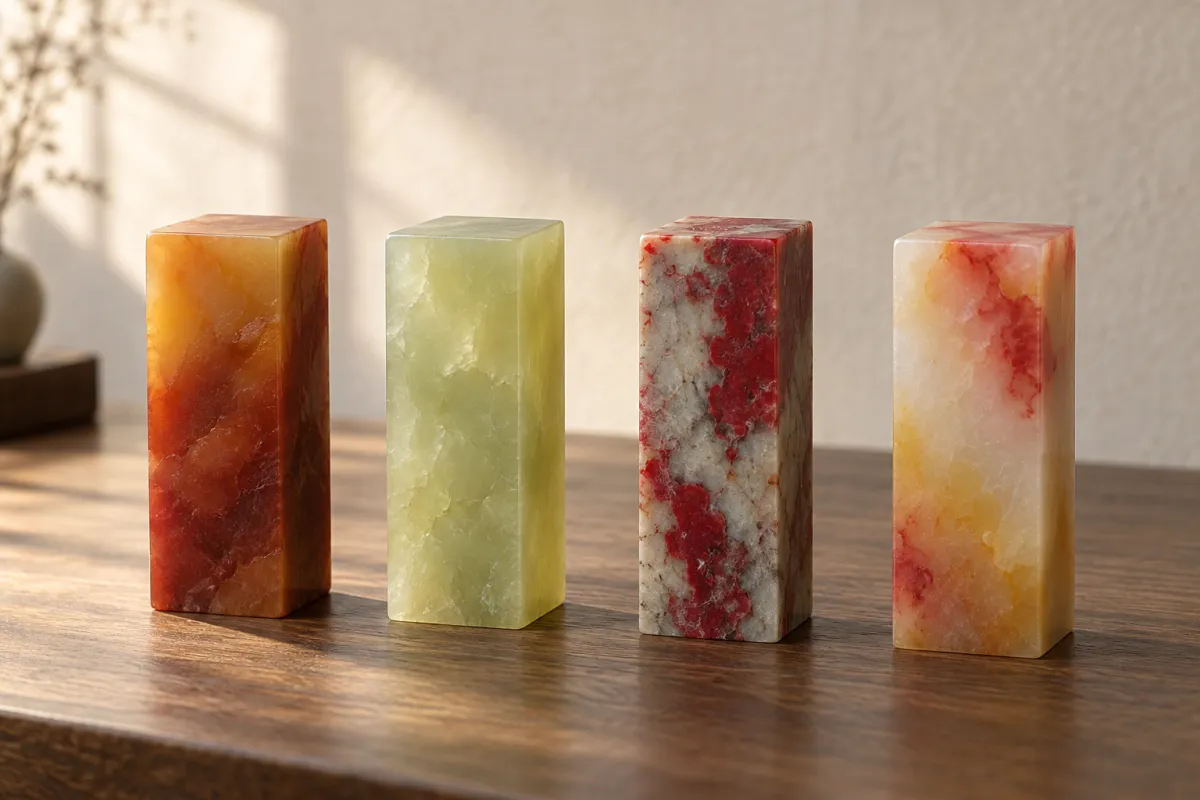
Most of the red seal marks on Chinese paintings and calligraphy were stamped with seals carved from soft stone. Of the many stones that carvers have used, four are named above the rest: the four great seal stones (四大印石, sì dà yìnshí). Two come from Zhejiang, one from Fujian and one from the grasslands of Inner Mongolia. This guide explains why soft stone mattered so much, what these stones are made of, and how the four differ.
Why soft stone changed seal carving
For most of Chinese history, seals were made of hard materials: bronze and other metals, jade, ivory, bamboo and hardwood. A scholar might write out the characters, but a specialist craftsman cast or cut the seal. Stone became steadily more popular after the Yuan dynasty (1271–1368), and it changed who could make a seal.
Tradition gives much of the credit to Wang Mian (王冕, Wáng Miǎn, 1287–1359), a late Yuan painter and poet. A biography of him by the Qing scholar Zhu Yizun says he “began using flower-milk stone (花乳石, huārǔ shí) to carve private seals.” Nobody can say for certain which stone “flower-milk stone” was.
The habit spread in the Ming dynasty. In his 17th-century Biographies of Seal Carvers (印人传, Yìnrén zhuàn), Zhou Liangong tells how Wen Peng (文彭, Wén Péng), son of the painter Wen Zhengming, used to write his designs and have a craftsman cut them in ivory. Then he bought four baskets of “lamplight” (灯光, dēngguāng) stone in Nanjing, and after that he stopped making ivory seals. According to Zhou, this is how “frozen stone” (冻石, dòngshí), the name for translucent seal stone, became known, and its price kept rising.
Soft stone let a scholar design and cut his own seal with a knife, as an art in its own right. That art is called zhuanke (篆刻, zhuànkè), and it has grown around these stones ever since.
What seal stones are made of
Seal stones are often sold in English as “soapstone,” but they are not true soapstone, which is made of talc. A recent German gemmological study notes that the Shoushan and Qingtian stones are not talc rocks. They formed when hot fluids altered volcanic rock, leaving aluminium silicate minerals such as pyrophyllite, kaolinite and illite (or muscovite). The mix varies from stone to stone:
- Shoushan: Fujian’s local standard divides it into Gaoshan-type stones (mostly kaolinite-group minerals, chiefly dickite), Furong-type stones (mostly pyrophyllite) and Wenyang-type stones (mostly illite), plus Tianhuang.
- Qingtian: mostly pyrophyllite, with some dickite-, illite- and sericite-rich varieties.
- Changhua: in chicken-blood stone, a ground of dickite and kaolinite with quartz, coloured red by cinnabar.
- Balin: defined in Inner Mongolia’s local standard as a clay rock made mainly of kaolinite and dickite.
Pure pyrophyllite and dickite rate only about 1.5 to 2 on the Mohs scale. Real seal stones contain other minerals and usually test harder. GIA gives chicken-blood stone a Mohs hardness of 3, and a study of Balin chicken-blood stone measured roughly 2 to 2.5. That softness is the point: the stone cuts cleanly with a steel blade but holds a crisp edge. It also means the stones scratch and chip more easily than jade or quartz.
Shoushan stone
Shoushan stone (寿山石, Shòushān shí) comes from the hills around Shoushan village in Jin’an District, on the northern edge of Fuzhou, Fujian. People there have carved it for more than 1,500 years. Traditionally it is sorted into field, water and mountain stones. Its colours range from milky white through yellow and red to near black, and many pieces are translucent. The rarest and most prized variety is Tianhuang (田黄, tiánhuáng), a yellow field stone. Read the full Shoushan stone guide.
Qingtian stone
Qingtian stone (青田石, Qīngtián shí) comes from Qingtian County in Lishui, southern Zhejiang, mostly from the hills southeast of the county town. It is mainly pyrophyllite, and its typical colours are cool blue-greens, pale yellows and greys. Seal carvers like how crisply it cuts. Its classic varieties are Dengguang Dong (灯光冻, dēngguāng dòng) and Fengmen Qing (封门青, fēngmén qīng). Read the full Qingtian stone guide.
Changhua stone
Changhua stone (昌化石, Chānghuà shí) comes from Yuyan Mountain in northwest Zhejiang. The area once belonged to the old Changhua County and is now part of Lin’an District, Hangzhou. It is best known for chicken-blood stone (鸡血石, jīxuè shí), in which cinnabar paints red patches across a pale or translucent ground. GIA notes a Ming-dynasty seal of this material among the palace treasures. Read the Changhua and chicken-blood stone guide.
Balin stone
Balin stone (巴林石, Bālín shí) is mined in Bairin Right Banner, Chifeng, Inner Mongolia. It is the newcomer of the group. In 2001 an expert panel convened by the Gems & Jewelry Trade Association of China ranked it with the other three as one of China’s four famous stones. One master carver has noted that it has not been mined for long but is plentiful and comes in large blocks. It also produces chicken-blood stone, as well as translucent jelly stones and yellow Fuhuang (福黄, fúhuáng) stone. Read the Balin stone guide.
The four stones compared
| Stone | Where it comes from | Typical look | Carving feel | Famous variety |
|---|---|---|---|---|
| Shoushan | Jin’an District, Fuzhou, Fujian | Very wide colour range, many translucent stones | Fine, dense and smooth | Tianhuang (田黄) |
| Qingtian | Qingtian County, Lishui, Zhejiang | Cool blue-green, yellow and grey tones | Crisp and clean, a seal carver’s favourite | Dengguang Dong (灯光冻), Fengmen Qing (封门青) |
| Changhua | Yuyan Mountain, Lin’an District, Hangzhou, Zhejiang | Pale to translucent ground with red cinnabar | Soft in dickite-rich grounds, harder and grittier where quartz is high | Chicken-blood stone (鸡血石) |
| Balin | Bairin Right Banner, Chifeng, Inner Mongolia | Wide range, including jelly stones and large blocks | Soft and smooth | Balin chicken-blood, Fuhuang (福黄) |
Collectors sometimes speak of the “three treasures of seal stone” (印石三宝, yìnshí sānbǎo): Shoushan Tianhuang, Changhua chicken-blood and Qingtian Dengguang Dong. These rare varieties drive the headlines and the prices. Most working seals, though, are cut from ordinary stone of the same families.
Choosing a stone for your own seal
The famous names matter less than the piece itself. Look for a sound stone with no cracks, an even texture across the face and a colour you like. If you want a seal of your own name, Chop1 offers all four famous stones as well as crystal, jade and gold. Shoushan seals start at US$299 including express shipping, with a standard 3 × 3 cm face. Qingtian, Changhua, Balin, crystal, jade and gold are quoted with the design proof, as are custom sizes and knobs. You can try a design first in the free seal maker or read about the real stone seal.
Questions
What are the four famous seal stones of China?
They are Shoushan stone (Fujian), Qingtian stone (Zhejiang), Changhua stone (Zhejiang) and Balin stone (Inner Mongolia). In Chinese they are called the 四大印石, the four great seal stones, and are also grouped as China's four famous stones.
Are Chinese seal stones a kind of jade?
No. Seal stones are soft rocks made mainly of pyrophyllite, dickite, kaolinite or illite, roughly 2 to 3 on the Mohs scale. Jadeite is about 6.5 to 7, which is why jade seals are cut with abrasives and machines, while seal stones can be carved with a steel knife.
Why is it called chicken-blood stone?
Because of its red patches, which look like fresh blood. The red is cinnabar, a mercury sulfide mineral, scattered through a pale ground of dickite and kaolinite. It is found at Changhua in Zhejiang and in Balin in Inner Mongolia.
Which of the four stones is best for a first name seal?
For most people, a sound piece of Qingtian or ordinary Shoushan stone. Both carve cleanly and are widely available. Changhua and Balin are prized above all for their red chicken-blood stones, which cost more and need protecting from strong light.
Sources
- Seals – Chinese Scholar's Studio (St. Olaf College)
- Zhu Yizun, Pushuting ji, juan 64: Biography of Wang Mian (Wikisource)
- Zhou Liangong, Yinren zhuan (Biographies of Seal Carvers) (Wikisource)
- Chicken-Blood Stone from China – Gems & Gemology, Fall 1989 (GIA)
- Zhang Shouliang and Cui Wenyuan, Gemmological and mineralogical study of Balin chicken-blood stone (Journal of Gems and Gemmology, 2002)
- Material analysis for the origin determination of Chinese soapstone figures (German Gemmological Association)