
Balin Stone: Inner Mongolia's Seal Stone
Short answer: Balin stone is a soft seal and carving stone mined in Bairin Right Banner, Chifeng, in Inner Mongolia. It is the newest of China's four famous seal stones on the national market. It is known for its chicken-blood stones, translucent jelly stones and yellow Fuhuang stones.
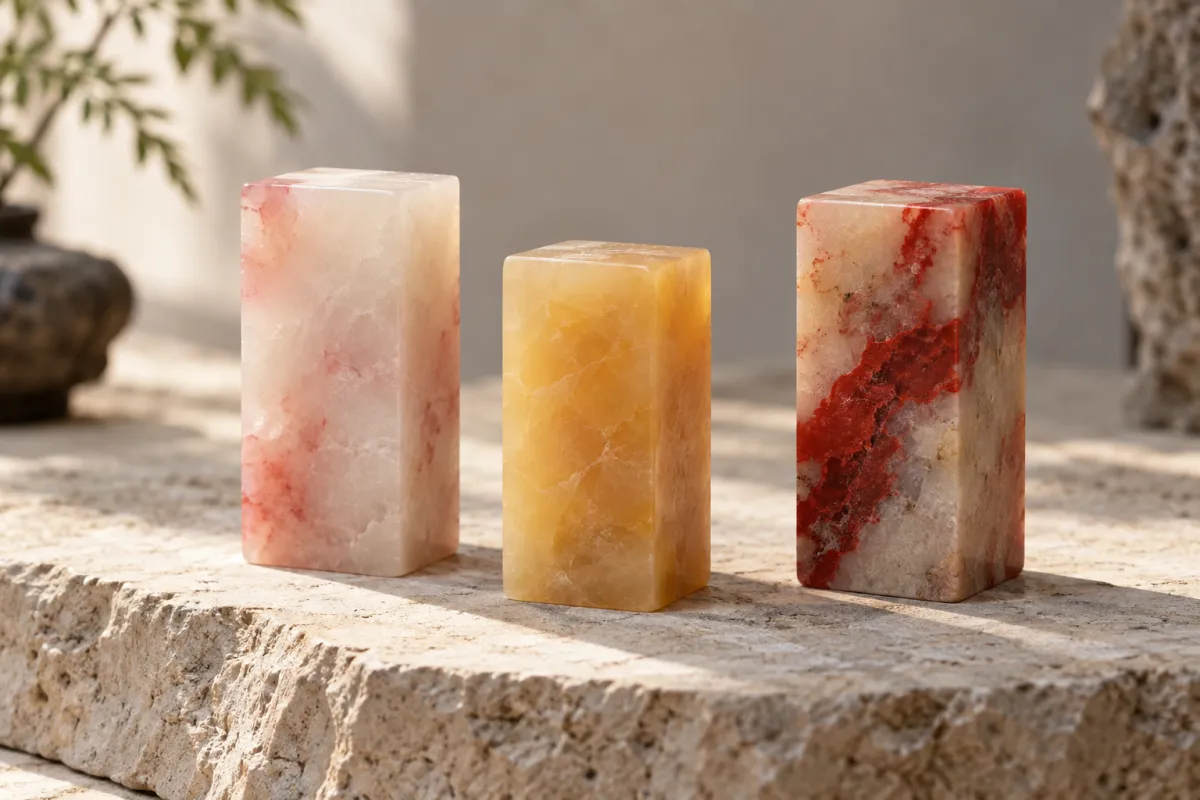
The other three of China’s four famous seal stones come from the green hills of Fujian and Zhejiang. Balin stone comes from the grasslands of Inner Mongolia, more than a thousand kilometres to the north. It is the newcomer of the group, but it yields chicken-blood stone, translucent jelly stones and yellow Fuhuang stone.
Where Balin stone comes from
Balin stone (巴林石, Bālín shí) is named after the Bairin (Balin) grasslands. It is mined in Bairin Right Banner (巴林右旗, Bālín Yòu Qí), a county-level banner of Chifeng (赤峰, Chìfēng) in eastern Inner Mongolia. Sources name the mining area slightly differently. A 2002 mineral study places it at Yamatu Mountain in the Greater Khingan range, about 50 km from the banner seat at Daban (大板). China’s heritage listing places it about 45 km from Daban on the Chabhu grassland.
Like the southern seal stones, Balin stone is altered volcanic rock. The 2002 study traces Balin chicken-blood stone to Late Jurassic rhyolitic rocks that were turned into kaolinite and dickite and, in places, mineralised with mercury, which became cinnabar.
A new name with old roots
Balin stone was being carved long before it reached seal carvers. China’s intangible heritage listing reports that ornaments carved from it have been found at sites of the Xinglongwa culture (about 8,000 years ago) and the Hongshan culture (about 6,000 years ago). These include jue rings, pendants, silkworms and birds.
As a seal stone, though, Balin is recent. Accounts differ on when it first reached seal carvers, but it joined the top rank only lately. In 2001 an expert panel convened by the Gems & Jewelry Trade Association of China, meeting to discuss candidates for a “national stone,” ranked Balin with Shoushan, Qingtian and Changhua as China’s four famous stones. A master carver interviewed in 2014 summed it up: Balin “has not been mined for long, the quantity is relatively large, and the blocks are thick enough for large seals and carvings.” Balin stone carving joined China’s national intangible cultural heritage list in 2021.
The main families of Balin stone
The heritage listing divides Balin stone into five broad families with more than a hundred varieties. Inner Mongolia’s local standard uses the first four.
Balin chicken-blood stone (鸡血石, jīxuè shí)
This is Balin stone with cinnabar. The red appears in bands, patches or scattered specks, usually on a greyish-white or black ground, with a waxy or greasy lustre. Varieties are named mostly after the colour of the ground. Examples include yellow-jelly, black-jelly, mutton-fat-jelly (羊脂冻), grey-jelly and Furong-jelly chicken-blood, as well as the multicoloured Liu Guan Zhang.
The ground differs from one variety to another. A 2002 study found that porcelain-white and grey-jelly bloodstones are made mainly of poorly ordered kaolinite, while black-jelly and Furong-jelly bloodstones are mainly dickite. GIA names Balin as one of only two Chinese sources of chicken-blood stone, the other being Changhua.
Fuhuang stone (福黄石, fúhuáng shí)
Fuhuang means “fortune yellow.” These are Balin’s yellow stones, and the name echoes Shoushan’s famous Tianhuang (田黄, “field yellow”).
Jelly stones (冻石, dòngshí)
Dong (冻, “frozen” or “jelly”) is the seal-stone word for translucent stone, and these are Balin’s clear and semi-clear stones without red. Names such as Furong jelly (芙蓉冻) and mutton-fat jelly (羊脂冻) also turn up as the grounds of chicken-blood stones.
Coloured stones (彩石, cǎishí)
These are the opaque, often multicoloured stones, used for both seals and carvings.
Pattern stones (图案石, tú’àn shí)
These are stones whose natural markings suggest pictures, which carvers can work into a design.
Colours
Balin covers a wide range of seal-stone colours. Its grounds run from white and grey to black, the Fuhuang stones add yellow, Furong-jelly stones are pinkish, and chicken-blood stones carry cinnabar red. The heritage listing sums up its qualities in six words very close to those used for Shoushan stone: fine, clean, moist, smooth, warm and dense (细、洁、润、腻、温、凝).
Hardness and carving
Balin stone is soft. The 2002 study measured Balin chicken-blood stone at a Mohs hardness of about 2 to 2.5, with a few samples above 3, and a density of about 2.6 g/cm³. For comparison, GIA gives chicken-blood stone in general a hardness of about 3. In practice, Balin cuts easily and smoothly with a steel knife. Its ample supply of large blocks makes it well suited to big seals and carvings.
The same softness calls for some care. Like all seal stones, it can chip if dropped, so keep it in a padded box. Chicken-blood pieces need extra protection: cinnabar is light-sensitive and can darken at the surface, so keep them out of direct sun and strong lamps. See seal paste and care for everyday handling.
Choosing a Balin stone
For a plain name seal, look for an even ground without cracks or gritty patches, in a colour you like. Chicken-blood stone is judged differently. Chinese researchers grading both Balin and Changhua bloodstone use the colour of the blood, the amount of blood, the type of ground and the clarity of the stone, with size and ground colour recorded as well. GIA’s rule of thumb is simpler: the more bright red and the cleaner the stone, the more it is worth. Because good bloodstone is costly, pressed and pigment-treated imitations exist (see the Changhua guide), so ask for a laboratory report on any expensive piece.
Chop1’s real seal can be made in Balin stone, hand-carved with a standard 3 × 3 cm face (or a custom size) and a hand-carved side inscription. Balin is priced on request and quoted with the design proof. The exact colour and pattern depend on the stone available. Reservations are open now, and ordering opens in mid-November 2026.
Questions
Where does Balin stone come from?
From Bairin Right Banner (巴林右旗) in Chifeng, Inner Mongolia, China. The mines lie in the hills of the Bairin grasslands, some 45 to 50 km from Daban, the banner's main town.
Is Balin chicken-blood stone the same as Changhua chicken-blood stone?
They are the same kind of stone from different places. Both get their red from cinnabar in a soft ground of kaolinite or dickite. Changhua in Zhejiang is the older and more famous source; Balin in Inner Mongolia is the only other source GIA names in China.
Is Balin stone good for seals?
Yes. It is soft and smooth to carve, and because it is plentiful and comes in large blocks it suits both everyday name seals and large seals. Chicken-blood pieces need protecting from strong light, like any cinnabar-bearing stone.
How hard is Balin stone?
Soft. A study of Balin chicken-blood stone measured a Mohs hardness of about 2 to 2.5, with a few samples above 3, which puts it among the softer seal stones and well below a steel knife.
Sources
- 石雕(巴林石雕)(Balin stone carving) – China Intangible Cultural Heritage Network
- Zhang Shouliang and Cui Wenyuan, Gemmological and mineralogical study of Balin chicken-blood stone (Journal of Gems and Gemmology, 2002)
- Wang Fuquun and Guo Jingfeng, Chicken-Blood Stone from China – Gems & Gemology, Fall 1989 (GIA)
- 去临安看四大名石 (The four famous stones on show in Lin'an) – Hangzhou.com.cn, 2014
- Cinnabar – Reference for Mineral Care (University of Oxford)