
How to Use Seal Paste and Care for a Stone Seal
Short answer: Traditional Chinese seal paste (印泥, yìnní) is finely ground cinnabar bound with aged oil, usually castor oil, and held together by a fiber such as moxa or silk. Stir it before use, tap the seal onto it lightly, wipe the seal face after stamping, and keep the paste covered and out of the sun. A soft-stone seal needs protecting from drops, heat and hard tools; jade, crystal and gold need different care.
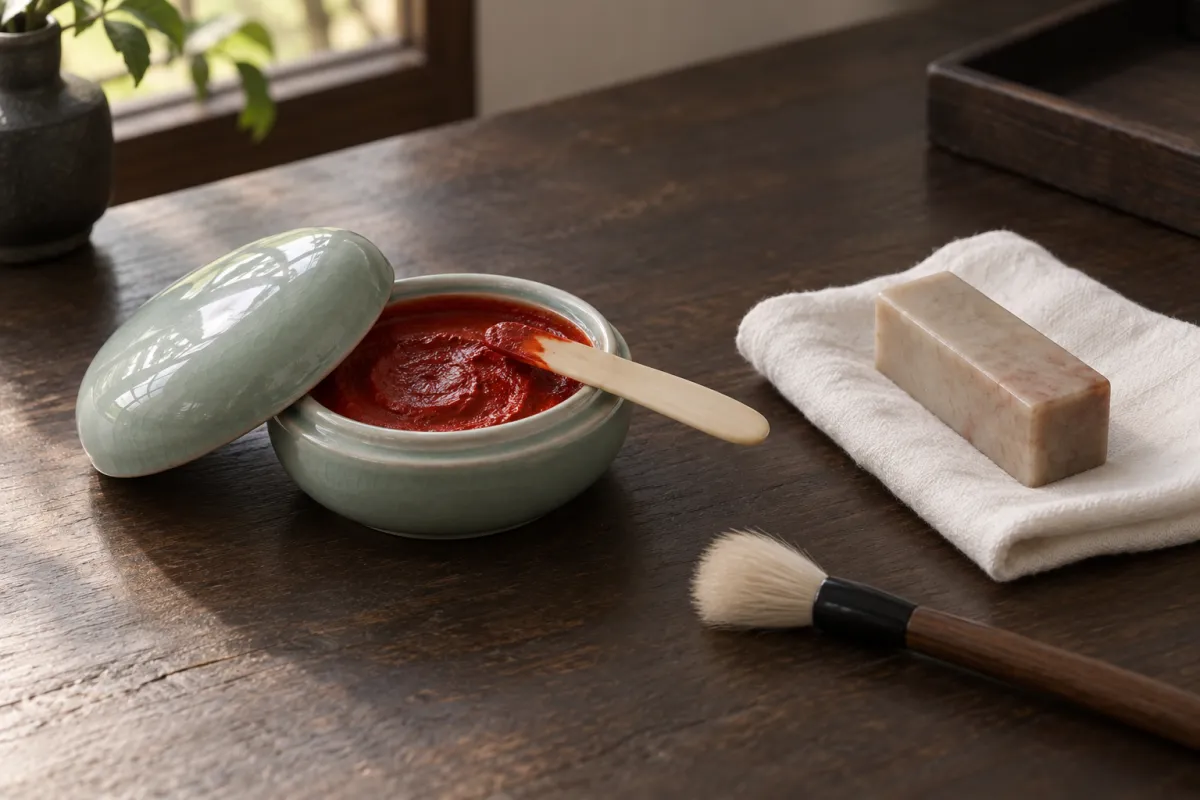
A good seal can last for generations, and a good pot of seal paste can last for years. Both need a little care. This guide covers what traditional paste is made of, how to stir it and ink a seal, how to keep the paste from drying out, and how to look after the seal itself, whether it’s soft stone, jade, crystal or gold.
What traditional seal paste is made of
Seal paste, 印泥 (yìnní, literally “seal mud”), is not ink in the usual sense. It is a thick, oily paste with three main ingredients:
- Pigment. Traditionally cinnabar (朱砂, zhūshā), a natural mercury sulfide mineral, ground very fine. It gives the warm vermilion red of Chinese seals.
- Oil. Usually castor oil (蓖麻油, bìmáyóu), refined and aged so it thickens. It carries and binds the pigment.
- Fiber. Most often moxa floss (艾绒, àiróng), the soft fiber of dried mugwort leaves, which holds the oil and pigment together and gives the paste its spring. Some pastes use silk fibers instead.
The fiber changes the character of the paste. Silk-based paste tends to be thick, oily and bright. Moxa-based paste is looser, less oily and dries faster.
Two traditional pastes appear on China’s national list of intangible cultural heritage, added in 2008. For Shanghai’s Lu’an paste (鲁庵印泥), the listing describes pounding mugwort leaves into a cotton-like floss, then mixing it again and again with aged castor oil and cinnabar. The work is split into three stages: grinding the cinnabar, rubbing the moxa and preparing the oil. Zhangzhou Babao paste (漳州八宝印泥, “eight treasures”) from Fujian adds precious materials such as pearl, agate and gold leaf. Exact recipes vary by maker, and many are trade secrets. Many inexpensive modern pastes use synthetic red pigments instead of cinnabar.
A note on safety: cinnabar contains mercury. Don’t eat or drink while you work with it, wash your hands afterward, and keep the paste away from children and pets.
Stirring the paste
Paste separates as it sits. The oil settles and seeps out, and the surface can go lumpy or fuzzy. Before a stamping session:
- Use a spatula to lift the paste from the edges and fold it toward the center, working all the way around the pot. Traditional spatulas are bone, horn or bamboo.
- Keep folding until the color and texture look even.
- Press it into a smooth, rounded dome. This gives you an even surface to ink from.
If you rarely use your paste, give it a stir now and then anyway, so the oil doesn’t separate out. In cold weather paste stiffens, so let it warm to room temperature before stirring.
Inking the seal
Tap the seal face onto the dome lightly, several times, rather than pressing or grinding it in. Check the face. You want an even, thin coat of red over every raised part. Too much paste fills fine lines and blurs edges, especially on red-character seals. For placement and pressure, see where to stamp a seal.
Keeping paste in good condition
- Container. Store paste in a glazed porcelain or ceramic jar with a lid. Metal can react with the paste, and wood soaks up its oil.
- Lid on. Keep the lid closed when you’re not using it. If you use the paste rarely, seal the gap with tape.
- Temperature and light. Keep it at room temperature, out of direct sunlight.
- Too oily. If fresh paste is very oily, lift some of the excess off with a piece of clean paper before stirring.
- Too dry. Advice differs. Some guides suggest working in a little castor oil. Others warn that added oil makes impressions bleed. The safest course is to ask the maker, or to replace the paste.
Cleaning the seal face
After stamping, press the seal a few times on scrap paper to take off most of the leftover paste. Then wipe the face gently with soft paper or a soft cloth, so dust doesn’t build up in the carved lines. Don’t pick at the lines with a needle, knife or other metal tool. A soft brush is gentler if paste has dried in fine grooves.
Caring for a soft-stone seal
Shoushan, Qingtian, Changhua and Balin stones, the four famous seal stones, are soft enough to carve with a steel knife. That also means they scratch, chip and crack more easily than most people expect.
- Drops and knocks. Stamp over a table, not your lap. Store each seal in a fitted box or pouch, and don’t let seals rattle against each other or against metal objects.
- Heat and sun. A Chinese guide to Shoushan stone published by Artron puts this first: keep the stone from drying out, and keep it away from high heat. That means no windowsills in direct sun and no shelves above radiators.
- Cleaning. The same guide recommends wiping with a soft silk cloth and never scraping with metal or other hard objects. Don’t soak a stone seal or scrub it with household cleaners.
- Handling. Regular handling suits a seal. Over time it gives the stone a soft sheen.
- Oil. Some collectors give Shoushan stones a very thin film of oil, but the Artron guide warns that not every Shoushan stone should be oiled and that practice differs by variety. If you’re not sure, skip it. Handling and a soft cloth are enough.
For more on individual stones, see our guides to Shoushan and Qingtian.
Jade, crystal and gold seals
Harder materials need less babying, but they are not indestructible.
- Jade. GIA (the Gemological Institute of America) rates jadeite at 6.5 to 7 and nephrite at 6 to 6.5 on the Mohs scale, so jade resists everyday scratches far better than seal stone. Both types are exceptionally tough and resist chipping. Because jade is often treated, GIA says warm, soapy water is always a safe way to clean it. Heat from a torch and warm acids can harm it.
- Crystal. Natural rock crystal is quartz, which defines 7 on the Mohs scale. It shrugs off most scratches, but a hard knock can still chip an edge. Wipe it clean after use.
- Gold. Pure gold is soft, about 2.5 on the Mohs scale, and very malleable, so it scratches and dents easily. It doesn’t react with oxygen and resists most acids, so it won’t rust or corrode. Wipe it with a soft cloth and keep it away from abrasive polishes and harder objects.
Whatever the material, wipe the paste off after each use and store the seal where it can’t fall.
Modern ink pads and their trade-offs
Many people now stamp seals on sponge or felt ink pads, and red chemical inks are common for everyday document stamping.
Advantages:
- inexpensive and easy to find
- clean, with no stirring
- dry quickly
- easy to carry
Drawbacks:
- the red is usually flatter and less deep than cinnabar paste
- some inks fade or bleed on absorbent paper
- quality varies a lot, so look for inks labeled archival or lightfast if the impression needs to last
A sensible approach is to use a pad for everyday mail and traditional paste for artwork, gifts and anything you want to keep.
Chop1 seals
A Chop1 seal in Shoushan, Qingtian, Changhua or Balin stone is hand-carved, or laser-engraved and hand-finished if it includes the hidden QR code. Crystal, jade and gold seals are machine-engraved and hand-finished. The standard size is a 3 × 3 cm face (custom sizes are quoted), and the care above applies to each material. You can design one in the free online studio and reserve a real seal now.
Questions
What is Chinese seal paste made of?
Traditionally, three things: cinnabar (a mercury sulfide mineral) for the red color, aged castor oil as the binder, and a fiber, usually moxa floss from mugwort leaves or sometimes silk, to hold it together. Many modern pastes use synthetic red pigments instead of cinnabar.
Why does seal paste need stirring?
Because it separates. Over time the oil settles and seeps out, and the surface can go uneven or fuzzy. Folding the paste with a spatula from the edges to the center and shaping it into a smooth dome mixes the oil back in and gives an even surface to ink from.
How do I clean a stone seal after use?
Stamp it a few times on scrap paper, then wipe the face gently with soft paper or a soft cloth. Don’t scrape the carved lines with metal tools, and don’t soak a soft-stone seal in water.
Can I use an ordinary ink pad with a Chinese seal?
Yes. A stamp pad is cheap, clean and quick to dry, and it works for everyday use. For artwork and anything you want to last, traditional seal paste gives a deeper, more even red.