
Qingtian Stone: Zhejiang's Classic Carving Stone
Short answer: Qingtian stone is a soft stone, mostly pyrophyllite, from Qingtian County in Lishui, southern Zhejiang. Seal carvers value it for its clean, crisp cut and its cool green, blue and yellow tones. Its finest varieties, Dengguang Dong and Fengmen Qing, rank among the classic seal stones.
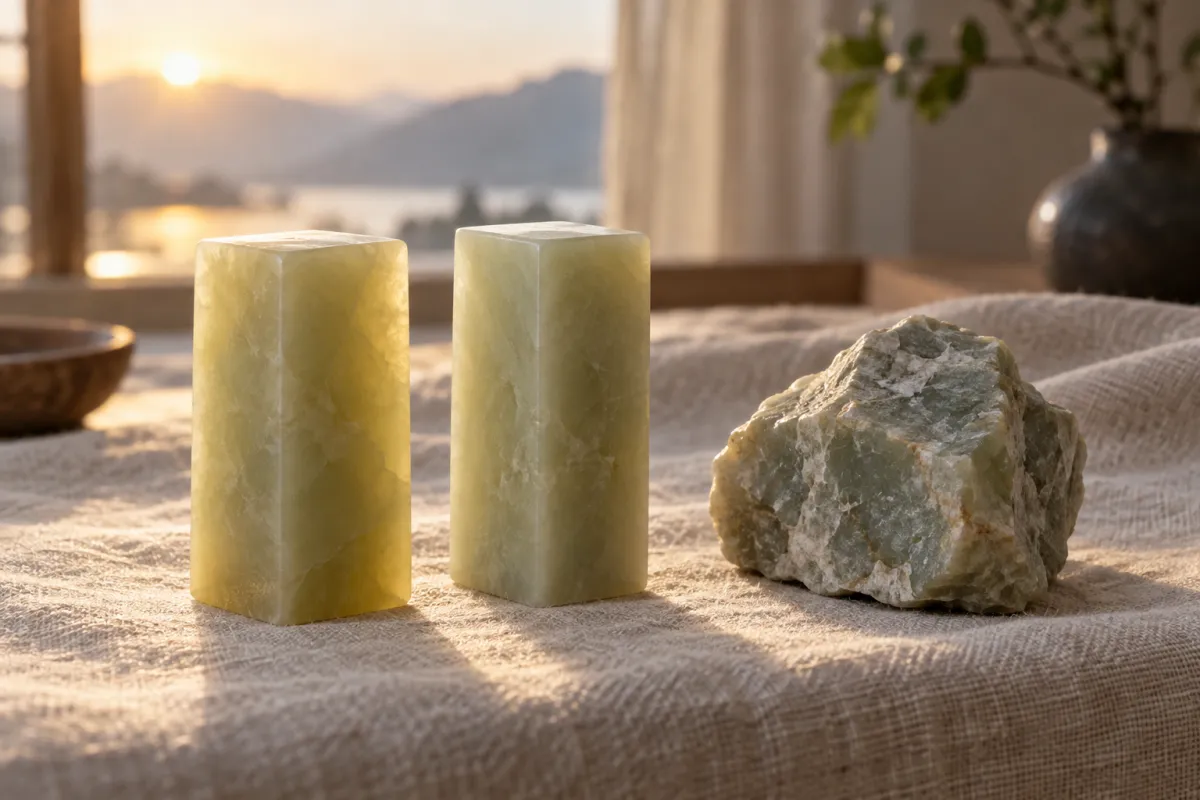
If Shoushan stone is the collector’s stone, Qingtian is the carver’s stone. It cuts cleanly, holds a sharp line and comes in cool, quiet colours. It is one of China’s four famous seal stones, and in its home county it supports a carving tradition recognised as national heritage.
Where Qingtian stone comes from
Qingtian stone (青田石, Qīngtián shí) is named after Qingtian County (青田县), in the southeast of Lishui in southern Zhejiang. Most of it comes from the hills southeast of the county town. The best-known sources include Shankou (山口), Fangshan (方山), Baiyang (白垟) and Fengmen Hill (封门山). Specialists group the stones by source, such as Fengmen, Zhoucun, Beishan and Shanpao stones, and count more than a hundred named varieties.
What it is made of
Most Qingtian stone is pyrophyllite (叶蜡石, yèlàshí), a soft aluminium silicate. Not all of it is, though. Mineral studies have identified varieties made mainly of dickite, illite or sericite, and these can feel and behave quite differently under the knife. A study of stones from the Fengmen mining area, for example, found:
- Fengmen Qing and Jinyu Dong (金玉冻) are fairly pure pyrophyllite
- Huangjin Yao (黄金耀, “golden shine”) is mostly illite with a little pyrophyllite
- Dengguang Dong is also pyrophyllite, with a highly ordered crystal structure
A few varieties carry harder minerals. The blue spots in “blue flower nails” (蓝花钉, lánhuā dīng) stone are partly corundum, the mineral of ruby and sapphire, which is far harder than any carving knife. A comparison study notes that Qingtian is generally less translucent than Shoushan. Some varieties are also prone to cracking after wet cutting, polishing or exposure to the sun.
A long history in seal carving
Carving in Qingtian is old. China’s heritage listing traces the local craft back to the Six Dynasties (3rd–6th centuries). The stone’s role in seal carving is linked to two famous stories, and both deserve a little care.
The first concerns Wang Mian (王冕, Wáng Miǎn, 1287–1359), a late Yuan painter and poet. A Qing biography by Zhu Yizun records that he “began using flower-milk stone (花乳石, huārǔ shí) to carve private seals.” Some modern writers identify flower-milk stone with Qingtian, but the old text does not say where the stone came from.
The second is told in Zhou Liangong’s 17th-century Biographies of Seal Carvers (印人传, Yìnrén zhuàn). The Ming carver Wen Peng (文彭, Wén Péng) came across a dispute over four baskets of stone in Nanjing, paid the porters and took the stone home. It proved to be what was then called “lamplight” (灯光, dēngguāng) stone. Wen had used ivory until then. After this he made no more ivory seals, and translucent “frozen stone” (冻石, dòngshí) became famous. Zhou says only that the stones “came from the river” (石从江上来). Today, though, the name dengguang belongs to Qingtian’s most prized variety, and the story is often told as the moment Qingtian stone entered the scholar’s studio.
Famous varieties
- Dengguang Dong (灯光冻, dēngguāng dòng, “lamplight jelly”): pale yellow, pure, fine and semi-translucent. It is the top grade of Qingtian. With Shoushan Tianhuang and Changhua chicken-blood stone, it is sometimes counted among the “three treasures of seal stone” (印石三宝).
- Fengmen Qing (封门青, fēngmén qīng, “Fengmen green”): a soft blue-green, semi-translucent stone from Fengmen Hill, and a fairly pure pyrophyllite.
- Yunao Dong (鱼脑冻, yúnǎo dòng, “fish-brain jelly”): bluish-white and semi-translucent.
- Zhuye Qing (竹叶青, zhúyè qīng, “bamboo-leaf green”): blue-green with yellow spots and red streaks, from Zhoucun.
- Huangjin Yao (黄金耀, “golden shine”): a yellow stone, mineralogically closer to illite than pyrophyllite.
Blue-green is the dominant Qingtian colour, which suits the county’s name: qing (青) means blue-green. Yellow, white and grey stones are common too.
Qingtian stone carving as a craft
Beyond seals, Qingtian is a carver’s material on a larger scale. Qingtian stone carving (青田石雕) was entered on China’s first national list of intangible cultural heritage in 2006. The listing describes the stone as warm in texture, “crisp yet soft” (脆软相宜), richly coloured and patterned. Carvers choose a design to fit each stone’s shape and colours. They work in the round, in high and low relief and in line carving, and the county is especially known for openwork (镂雕, lòudiāo). Typical subjects include flowers, birds, fish, insects, landscapes and figures.
The listing also records awards for Qingtian carvings at international exhibitions in the early 20th century, including the 1915 Panama–Pacific International Exposition in San Francisco. It is frank about the craft’s problems, too. After more than a thousand years of mining, high-quality pyrophyllite is close to exhausted, so fine stones such as Fengmen Qing and Dengguang Dong are scarce.
What Qingtian is like to carve
A master carver interviewed at a 2014 exhibition of the four famous stones put it simply: Qingtian is mainly used for seal carving, is the stone seal carvers like best, and “best expresses the flavour of seal carving.” In practice, good Qingtian cuts with a clean, slightly crisp feel, and strokes come out sharp. That suits anyone who wants the lines of seal script to look cut by a knife rather than printed.
Pick a stone without visible cracks or hard blue spots. Keep the finished seal out of direct sun and away from heat.
Chop1’s real stone seal can be cut from Qingtian stone. The standard face is 3 × 3 cm, and you can choose a carved beast knob or a plain top. The face is hand-carved, or laser-engraved and hand-finished if you add the hidden QR code, and the side inscription is carved by hand. Qingtian is quoted with the design proof; Chop1’s starting price of US$299 including express shipping is for Shoushan stone. Reservations are open now, and ordering opens in mid-November 2026. To compare it with Fujian’s stone, read Shoushan vs Qingtian.
Questions
Where does Qingtian stone come from?
From Qingtian County in Lishui, Zhejiang Province, China, mainly from hills southeast of the county town such as Shankou, Fangshan and Fengmen Hill.
What is Dengguang Dong?
Dengguang Dong (灯光冻, 'lamplight jelly') is the most prized Qingtian variety: a pale yellow, pure, semi-translucent pyrophyllite. Collectors sometimes rank it with Shoushan Tianhuang and Changhua chicken-blood stone as one of the three treasures of seal stone.
Is Qingtian stone good for a name seal?
Yes. Qingtian is mainly used for seal carving and is a favourite of seal carvers because it cuts cleanly and crisply. A sound piece without cracks or hard blue spots makes an excellent name seal.
Is Qingtian stone carving recognised as cultural heritage?
Yes. Qingtian stone carving was entered on China's first national list of intangible cultural heritage in 2006.
Sources
- 青田石雕 (Qingtian stone carving) – China Intangible Cultural Heritage Network
- 青田石 (Qingtian stone) – Chinese Wikipedia
- Zhu Yizun, Pushuting ji, juan 64: Biography of Wang Mian (Wikisource)
- Zhou Liangong, Yinren zhuan (Biographies of Seal Carvers) (Wikisource)
- Xing Wanli et al., Mineralogical characteristics of several representative Qingtian stones (Journal of Gems and Gemmology)
- 去临安看四大名石 (The four famous stones on show in Lin'an) – Hangzhou.com.cn, 2014