
Shoushan vs Qingtian Stone: Which Is Better for a Seal?
Short answer: Neither stone is better in every way. Shoushan offers warmer colours, more translucent varieties and a smooth, dense cut. Qingtian is usually cooler in colour, crisp to carve and often more affordable. For a first personal name seal, a sound piece of ordinary Qingtian or mountain-pit Shoushan works well; the rare varieties matter more to collectors than to the stamp.
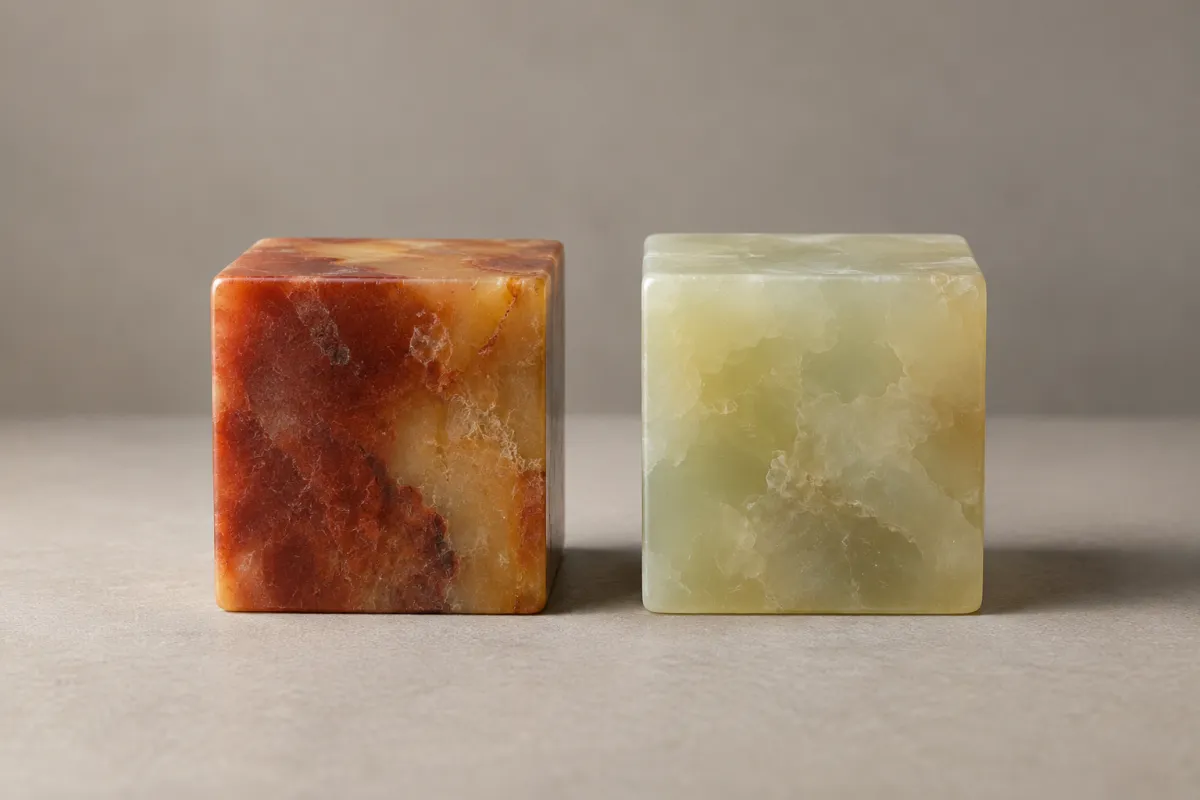
If you are choosing a stone for your first Chinese seal, a common choice is between two names: Shoushan (寿山石, Shòushān shí) from Fujian and Qingtian (青田石, Qīngtián shí) from Zhejiang. Both are among China’s four famous seal stones, both carve beautifully, and both have centuries of seals behind them. They differ in colour, feel and price, and in the ways a buyer can be misled.
At a glance
| Shoushan stone | Qingtian stone | |
|---|---|---|
| Where | Jin’an District, Fuzhou, Fujian | Qingtian County, Lishui, Zhejiang |
| Main minerals | Dickite and other kaolinite-group minerals, pyrophyllite or illite, depending on the family | Mostly pyrophyllite; some dickite, illite or sericite varieties |
| Typical colours | Very wide: white, yellow, red, grey, black and mixed | Mostly cool blue-green, also yellow, white and grey |
| Translucency | Many translucent “jelly” stones | Generally less translucent than Shoushan |
| Carving feel | Fine, dense, smooth | Crisp and clean |
| Famous varieties | Tianhuang, Furong, Gaoshan | Dengguang Dong, Fengmen Qing |
| Price range | Very wide, up to Tianhuang at prices per gram | Modest for everyday stone; fine varieties scarce and costly |
Look
Shoushan is the more colourful of the two. One district outside Fuzhou yields white, yellow, red, grey and black stones, and its water-pit and field stones are often translucent. The yellow Tianhuang is the most famous. Gaoshan and Furong are two of the best-known mountain-pit families. (See the Shoushan stone guide.)
Qingtian’s usual colour suits its name: qing (青) means blue-green, the commonest shade. Yellow, white and grey stones are common too. The prized Fengmen Qing (封门青) is a soft, semi-translucent blue-green, and Dengguang Dong (灯光冻) is a pale, pure, semi-translucent yellow. A mineral comparison of the two stones notes that Qingtian is generally less translucent than Shoushan. (See the Qingtian stone guide.)
Feel and carving behaviour
Both stones are soft, roughly 2 to 3 on the Mohs scale, so a carver cuts them with a steel knife. The difference is in the feel.
- Qingtian is described in China’s heritage listing as “crisp yet soft” (脆软相宜). A master carver at a 2014 exhibition of the four famous stones said it is mainly used for seal carving, is the stone seal carvers like best and “best expresses the flavour of seal carving.” Strokes come out clean and sharp.
- Shoushan is praised for qualities summed up as fine, compact, moist, smooth, warm and dense (细、结、润、腻、温、凝). The same carver said Shoushan is appreciated for its bright colours as much as for the carving. It also has a long tradition of decorative knobs and shallow boyi (薄意) relief.
Within each stone the feel varies. Fujian’s standard sorts Shoushan into dickite-rich Gaoshan, pyrophyllite-rich Furong and illite-rich Wenyang families, which differ in density and texture. Some Qingtian contains blue spots of corundum, the mineral of ruby and sapphire, which no carving knife can cut, so a careful maker avoids them on a seal face.
Durability
Neither stone is tough. Both scratch and chip more easily than jade or glass, and either will break if dropped on a hard floor. A few habits protect both:
- Keep the seal in its box or a padded pouch.
- Keep it out of direct sun and away from heat. Some Qingtian varieties are known to crack after wet cutting, polishing or exposure to the sun.
- Wipe off seal paste after use. See seal paste and care.
Treated this way, either stone makes a seal you can use for many years.
Price, in plain terms
Ordinary seal blanks of both stones are modestly priced. Above that, the ranges differ. Shoushan runs from modest mountain-pit stones up to Tianhuang, which is rare enough to be priced by the gram. Qingtian’s best stones, Dengguang Dong above all, are also costly, and they are getting scarcer. China’s heritage listing notes that after more than a thousand years of mining, high-quality Qingtian pyrophyllite is close to exhausted.
How to spot dyed, fake and resin stones
Famous names attract imitations. Guides to authenticating Tianhuang describe several kinds, and much the same warnings apply to other seal stones.
- Substitutes: cheaper stones sold under a famous name, such as other Shoushan-area stones passed off as Tianhuang. A price far below what a variety normally costs is a warning sign.
- Plastic and resin: colour and texture are too even, the inside looks perfectly clean under a strong light, there is no natural skin, and the piece feels warm against the skin and noticeably light in the hand. Scraped with a blade, plastic comes off in flakes, while stone gives powder. Only ever try that on a hidden spot of a stone you own.
- Dyed stone: the colour looks too uniform, or brighter or deeper than natural stone.
- Glued pieces: small stones joined into a larger one. Look under magnification for glue lines, and under strong light for veins and patterns that stop abruptly.
For anything expensive, buy from a seller who names the variety in writing, and ask for a gem laboratory report. Instruments such as infrared spectroscopy can identify the minerals.
Which suits a first name seal?
For a first personal seal, a sound stone matters more than a famous variety. That means no cracks across the face, no hard spots, and a colour you will enjoy holding.
- Choose Qingtian if you like cool, quiet colours and want crisp, cleanly cut lines.
- Choose Shoushan if you prefer warmer colours, more translucency and a smooth, dense feel.
The other two famous stones are Changhua and Balin, known above all for red chicken-blood stone.
Chop1’s real seal starts at US$299 in Shoushan stone, including express shipping. Qingtian, Changhua, Balin, crystal, jade and gold are quoted with the design proof. The standard seal has a 3 × 3 cm face, a hand-carved side inscription and, if you like, a carved beast knob; a custom size or knob is quoted too. Reservations are open now, and ordering opens in mid-November 2026. You can try a design first in the free seal maker.
Questions
Is Shoushan stone better than Qingtian stone?
Not in every way. Shoushan has a wider colour range, more translucent varieties and the rarest collector's stones, while Qingtian is the seal carver's favourite for its crisp, clean cut. For the impression a seal leaves on paper, a sound stone of either kind works equally well.
Which is easier to carve, Shoushan or Qingtian?
Both are soft and carve easily with a steel knife. Qingtian tends to feel crisp under the blade; Shoushan tends to feel smooth and dense. Within each stone the feel varies by variety, and hard spots in some stones are the main thing to avoid.
How can I tell if a seal stone is dyed or plastic?
Be wary of colour and texture that are perfectly even, a stone that looks completely clean inside, and a piece that feels warm and unusually light. Dyed stone often looks too uniform or too bright. For valuable pieces, only laboratory testing is conclusive.
Which is more expensive?
It depends on the variety. Everyday stones of both kinds are modestly priced. Shoushan's Tianhuang is rare enough to be priced by the gram, and fine Qingtian such as Dengguang Dong and Fengmen Qing is also scarce and costly.
Sources
- 寿山石 (Shoushan stone) – Chinese Wikipedia
- 青田石 (Qingtian stone) – Chinese Wikipedia
- 去临安看四大名石 (The four famous stones on show in Lin'an) – Hangzhou.com.cn, 2014
- 青田石雕 (Qingtian stone carving) – China Intangible Cultural Heritage Network
- 田黄石的收藏与鉴定 (Collecting and authenticating Tianhuang) – rmzxw.com.cn
- Tang Deping et al., An analysis of the new local standard for Shoushan stone (Journal of Gems and Gemmology)