
Shoushan Stone: Fuzhou's Seal Stone and Tianhuang
Short answer: Shoushan stone is a soft, colourful carving stone mined around Shoushan village in Jin'an District, on the northern edge of Fuzhou in Fujian. It is traditionally sorted into field, water and mountain stones. Its rarest field stone, the yellow Tianhuang, is the most prized seal stone in China.
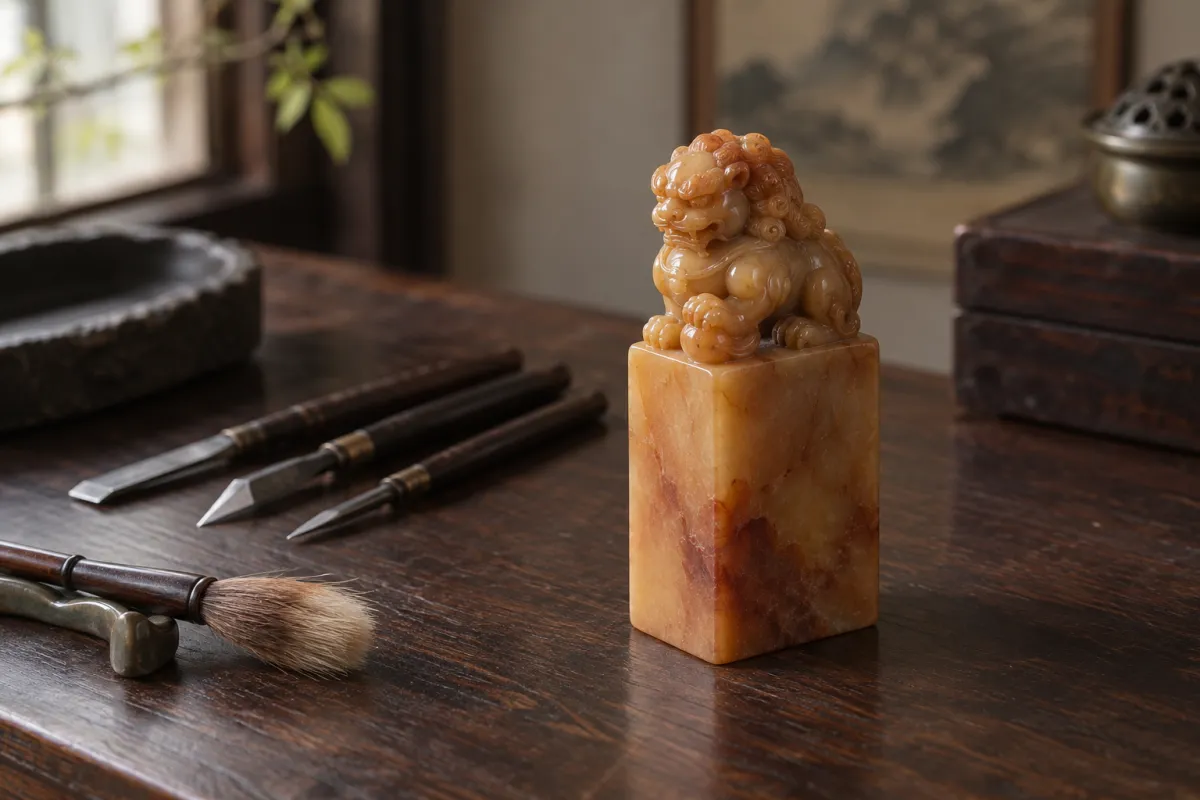
Shoushan stone is the best known of China’s four famous seal stones. It is also the most varied. One small district of hills and paddy fields outside Fuzhou produces milky white, honey yellow, peach red, grey and near-black stones, some as clear as jelly and others fully opaque. It also produces Tianhuang, the stone emperors collected.
Where Shoushan stone comes from
Shoushan stone (寿山石, Shòushān shí) is named after Shoushan village (寿山村) in Jin’an District (晋安区), on the northern outskirts of Fuzhou, the capital of Fujian Province. Most of it comes from Shoushan township and neighbouring Rixi township. As a Chinese geographical-indication product, the protected area also takes in a few nearby townships, including some in Lianjiang County.
Geologically, it is volcanic rock altered by hot fluids into fine, compact clay-family minerals. Fujian’s local standard (DB35/T 419—2012) sorts it by what it is made of:
- Gaoshan-type stones, made mainly of kaolinite-group minerals, chiefly dickite
- Furong-type stones, made mainly of pyrophyllite
- Wenyang-type stones, made mainly of illite
- Tianhuang-type stones, Shoushan stone that was carried downstream and buried
A long history
Shoushan stone was carved long before anyone made seals from it. In 1954, archaeologists working in Fuzhou found a small carved stone pig of Shoushan stone in a tomb of the Southern Dynasties (420–589). In 1965, a similar pair turned up in another tomb, alongside a brick dated to 445 CE. Large-scale mining began in the Song dynasty (960–1279), and the Hunan Museum notes that a poem by the Song scholar Huang Gan is the first known poem about the stone.
People began making seals from Shoushan stone at the end of the Yuan dynasty. Carving and collecting grew through the Ming and Qing. By the early Qing, famous carvers were working the stone, among them Yang Yuxuan (杨玉璇), whom the 17th-century critic Zhou Liangong singled out as the finest carver of seal knobs in the country. The Qing court was a major collector: according to a Palace Museum researcher, the museum holds nearly 2,000 Shoushan carvings left from the Qing palace. In 2006 Shoushan stone carving was entered on China’s first national list of intangible cultural heritage.
Field, water and mountain stones
Collectors have long sorted Shoushan stone by where it is found.
Field stones (田坑, tiánkēng)
These are loose pebbles buried in the paddy fields along the Shoushan stream. They are the rarest and, by long agreement, the finest. They are named by colour: yellow Tianhuang, white field (白田, báitián), red field (红田, hóngtián) and black field (黑田, hēitián).
Water stones (水坑, shuǐkēng)
These come from the Kengtou (坑头) vein to the south of Shoushan, where groundwater seeps through the rock. They tend to be clear and glossy. Classic names include Yunao Dong (鱼脑冻, yúnǎo dòng, “fish-brain jelly”), Tianlan Dong (天蓝冻, “sky-blue jelly”) and Taohua Dong (桃花冻, “peach-blossom jelly”).
Mountain stones (山坑, shānkēng)
These are mined from veins in the hills. They are the most widespread and have the most varieties. Two are especially well known:
- Gaoshan (高山, gāoshān): one of the main mountain-pit families, made of kaolinite-group minerals, chiefly dickite. It ranges from translucent to opaque, and studies link its clarity to how evenly the mineral grains crystallised.
- Furong (芙蓉, fúróng): stone from the Yueyang (月洋) area, mainly pyrophyllite, prized for its fine, smooth texture and often white or pinkish.
Why Tianhuang is so prized
Tianhuang (田黄, tiánhuáng, “field yellow”) is yellow Shoushan stone that broke away from its source vein, tumbled downstream and lay for a very long time in the soil beneath the paddy fields. Most pieces weigh tens to hundreds of grams. Big pieces are extremely rare, and fine Tianhuang is priced by the gram. Its yellows have names of their own, such as golden yellow (黄金黄), loquat yellow (枇杷黄) and osmanthus yellow (桂花黄).
Collectors look for three marks, though none of them is proof on its own:
- a weathered skin (石皮, shípí), white, yellow or black
- fine “radish threads” (萝卜纹, luóbo wén) visible when light shines through the stone
- red veins (红筋, hóngjīn), old cracks stained by iron in the wet soil
Its fame is not ancient. According to the Palace Museum researcher Yun Limei, before the Ming dynasty it was simply called “yellow stone” and was not especially valued. Its prestige rose sharply in the Qing. The Hunan Museum calls it the “Emperor of Stones” and quotes the saying that an ounce of Tianhuang is worth three ounces of gold. Other versions of the saying give four, and another goes “gold is easy to get, Tianhuang is hard to find” (黄金易得,田黄难求).
The best-known Tianhuang object is a set of three linked seals made for the Qianlong emperor and now in the Palace Museum in Beijing. The three seals and the chain joining them were carved from a single piece of stone. The seals read 乾隆宸翰 (“the Qianlong emperor’s brush”), 乐天 (“rejoicing in heaven”) and 惟精惟一 (“refined and single-minded”). The last emperor, Puyi, kept the set with him after he left the palace. It was shown in the Palace Museum’s centenary exhibition in 2025.
What Shoushan stone is like to carve
China’s heritage listing sums up the stone’s qualities in six words: fine, compact, moist, smooth, warm and dense (细、结、润、腻、温、凝). It is soft enough for a steel knife yet dense enough to hold sharp corners and thin lines. How it feels under the blade depends on the family: dickite-rich Gaoshan, pyrophyllite-rich Furong and illite-rich Wenyang stones differ in density and texture.
Fuzhou carvers have built a whole vocabulary of techniques on the stone. These include round carving, seal-knob carving, and boyi (薄意, bóyì), a very shallow relief. Seal engraving is on the list too.
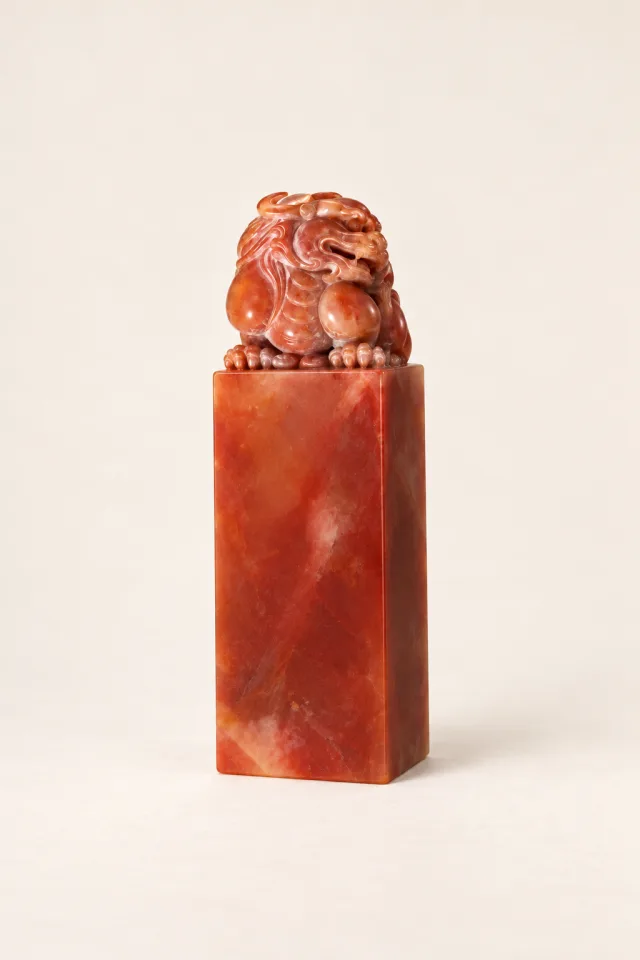
For a name seal, an ordinary mountain-pit stone such as Gaoshan is a sensible choice. Save Tianhuang for the collector’s cabinet. Chop1’s real stone seal can be cut from Shoushan stone with a standard 3 × 3 cm face, with or without a carved beast knob. The face is hand-carved, or laser-engraved and hand-finished if you add the hidden QR code, and the side inscription is carved by hand. It starts at US$299 including express shipping; a custom size or knob is quoted with the design proof. Reservations are open now, and ordering opens in mid-November 2026. To weigh it against its Zhejiang rival, see Shoushan vs Qingtian.
Questions
Where does Shoushan stone come from?
From the hills around Shoushan village and Shoushan township in Jin'an District, on the northern outskirts of Fuzhou, Fujian Province, China. The protected area for the name also takes in neighbouring townships.
What is Tianhuang stone?
Tianhuang is the yellow field stone of Shoushan: loose pebbles of Shoushan stone that were carried downstream and buried under the paddy fields along the Shoushan stream. It is translucent, usually has a weathered skin and fine internal threads, and is rare enough to be priced by the gram.
Is Shoushan stone good for a personal name seal?
Yes. Ordinary mountain-pit Shoushan stones such as Gaoshan are dense, smooth to carve and come in many colours, and they are widely used for name seals. Tianhuang and the finest jelly stones are bought mainly as collector's pieces.
Why is Tianhuang so expensive?
Because it is rare and comes from one small area. A Palace Museum researcher has put its value down to its quality and rarity, and a saying quoted by the Hunan Museum holds that an ounce of Tianhuang is worth three ounces of gold.
Sources
- 寿山石 (Shoushan stone) – Chinese Wikipedia
- 天工巧夺 寿山石雕 – People's Weekly (People's Daily)
- Why is Tianhuang called the 'emperor's stone'? – Fujian Daily via ifeng.com, 2016
- Shoushan stone seal with nine-dragon knob – Hunan Museum
- 田黄石的收藏与鉴定 (Collecting and authenticating Tianhuang) – rmzxw.com.cn
- Tang Deping et al., An analysis of the new local standard for Shoushan stone (Journal of Gems and Gemmology)