
Changhua Stone and Chicken-Blood Stone: A Guide
Short answer: Changhua stone comes from Yuyan Mountain in northwest Zhejiang, an area once part of the old Changhua County and now in Lin'an District, Hangzhou. Its most famous form is chicken-blood stone, whose red patches are cinnabar (mercury sulfide) set in a soft ground of dickite and kaolinite. Because cinnabar can darken in light, these stones are best kept out of the sun.
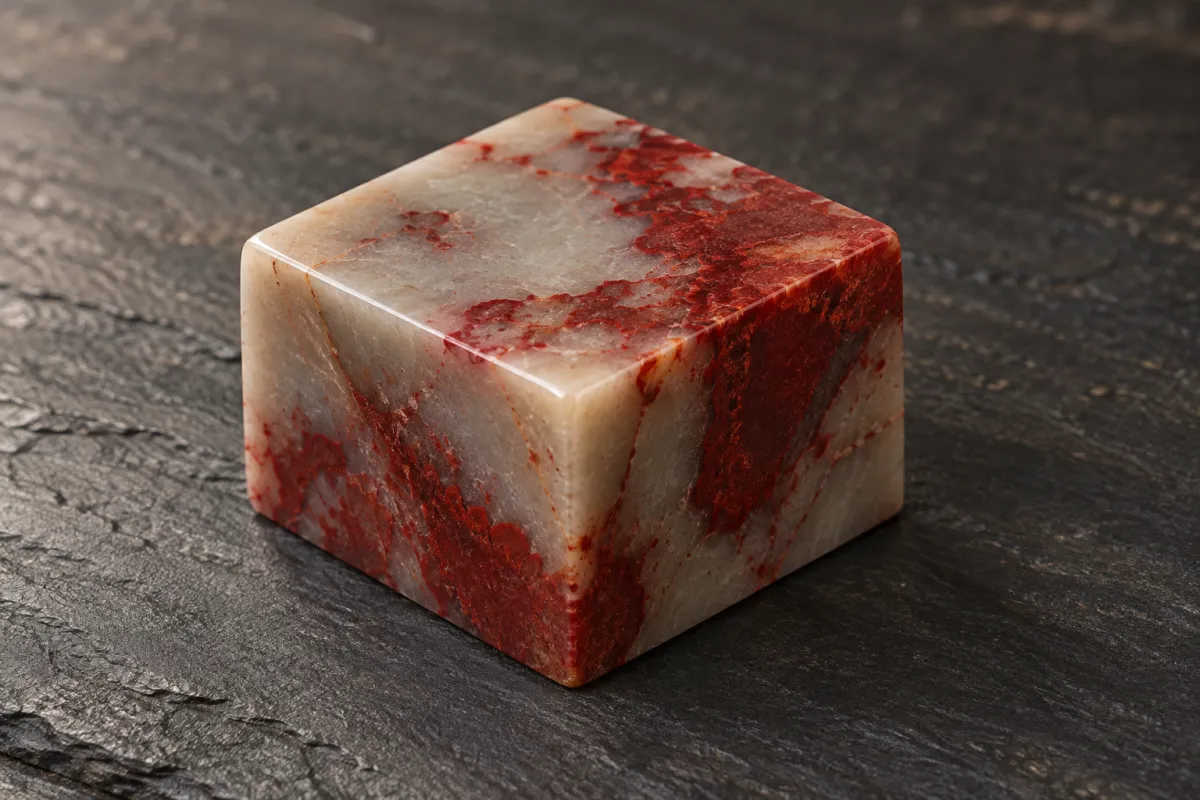
Few seal stones are as striking as chicken-blood stone: a pale or translucent body splashed with red, as if a few drops of fresh blood had soaked in. It is the signature product of Changhua, one of China’s four famous seal stones. It is also the one that needs the most care, because the red is cinnabar, a mineral that reacts to light.
Where Changhua stone comes from
Changhua stone (昌化石, Chānghuà shí) comes from Yuyan Mountain (玉岩山, Yùyán Shān) in the hills of northwest Zhejiang. According to China’s intangible heritage network, the area once belonged to Changhua County (昌化县), hence the name. Today it lies in Lin’an District, part of the city of Hangzhou. The national listing for chicken-blood stone carving places the craft in Daxiagu town in Lin’an and its raw material at Yuyan Mountain. A China Daily report describes the source as the headwaters of the West Zhejiang Grand Canyon. At the time of GIA’s 1989 report, all mining there was in underground tunnels.
Changhua produces much more than chicken-blood stone. Its stones come in red, yellow, brown, white, sky blue and green, and translucent jelly stones are also found there. One master carver has counted five broad series and more than 130 varieties. Bright red chicken-blood, though, is the rare and costly part.
What makes the “blood” red
Chinese collectors describe a chicken-blood stone in two parts: the blood (血, xuè) and the ground (地, dì).
- The blood is cinnabar (辰砂, chénshā), a mercury sulfide mineral. Under the microscope it is a mass of tiny cinnabar crystals. Research on Changhua samples links differences in its red to how those crystals cluster and to traces of selenium.
- The ground is mostly dickite and kaolinite, with varying amounts of quartz and other minerals. GIA describes the whole stone as a fine-grained mixture of dickite/kaolinite and quartz with varying amounts of cinnabar. It gives a Mohs hardness of about 3 and a specific gravity of 2.6 to 3.0.
Value depends above all on the blood. GIA notes that the more bright red a piece has and the cleaner it is, the more it is worth. Chinese researchers have proposed grading on blood colour, amount of blood, type of ground and clarity, with size and ground colour recorded as well.
Frozen, soft and hard grounds
The ground decides how a stone looks and how it carves. Collectors use a scale running from frozen ground (冻地, dòngdì), which is translucent and jelly-like, through soft ground (软地, ruǎndì) to firm and hard ground (刚地, gāngdì and 硬地, yìngdì).
Mineral studies of Changhua stone explain the scale. The more dickite in the ground, and the better ordered its crystals, the better the ground. As alunite and quartz come in, the stone becomes less translucent and harder. Once quartz passes about 25 percent, the ground counts as poor “hard ground.” For a carver, a frozen or soft ground cuts smoothly with a knife. Quartz is harder than a steel blade, so quartz-rich hard grounds are much harder going.
Named varieties
Chicken-blood stones are often named for the look of the blood or the type of ground. Two well-known names:
- Dahongpao (大红袍, dàhóngpáo, “great red robe”): a stone red almost all over, regarded as the top grade.
- Liu Guan Zhang (刘关张, Liú Guān Zhāng): a stone showing red, black and white together. It is named after the three sworn brothers Liu Bei, Guan Yu and Zhang Fei of the Romance of the Three Kingdoms, of whom Guan Yu is traditionally shown with a red face and Zhang Fei with a black one.
Grounds are described as well, as in jelly-ground (冻地) or soft-ground (软地) chicken-blood.
A short history
GIA’s authors wrote in 1989 that old texts show the stone had been known in China for more than 500 years. A seal carved from it is listed among the palace treasures of the Ming dynasty (1368–1644), and the authors reported early carvings on exhibit in the Palace Museum in Beijing. China’s heritage listing adds that carvers settled near the source in the mid-Qing, building a local carving lineage, and that chicken-blood pieces were once sent as tribute and used for imperial seals. Chicken-blood stone carving from Lin’an joined China’s national intangible cultural heritage list in 2008.
Caring for chicken-blood stone
Cinnabar is the reason this stone needs more care than other seal stones. A University of Oxford mineral care reference calls it “notoriously photosensitive, irreversibly blackening with light exposure.” The reaction needs light, moisture and chlorides together, and it is worse in humid air. Strong heat also darkens cinnabar. Not every piece reacts: some cinnabar specimens have stayed bright red for years in sunlight. Still, there is no way to tell in advance, and the damage cannot be undone.
Sensible habits:
- Keep the seal in its box, out of direct sun. Don’t leave it on a sunny windowsill or under a strong display lamp.
- Keep it away from heat sources, and don’t clean it with hot water or chemicals.
- Wipe off seal paste after use with a soft dry cloth (see seal paste and care).
- Don’t sand, grind or re-polish the red areas yourself. Cinnabar is a mercury mineral, and that work is best left to a carver.
Watch for imitations
Because good chicken-blood stone is costly, imitations are common. Researchers have documented fakes made by grinding a cheaper chlorite mineral and pressing it with a red organic pigment. They have also documented treated stones that use glue and red pigment. Raman spectroscopy can tell natural stone (dickite and cinnabar) from imitations (organic materials), so for a valuable piece, ask for a laboratory report.
Chop1’s real seal can be made in Changhua stone, hand-carved with a 3 × 3 cm face. It is priced on request and quoted with the design proof, and because every stone is different, the amount of red cannot be promised in advance. Reservations are open now, and ordering opens in mid-November 2026. For the other source of chicken-blood stone, see the Balin stone guide.
Questions
What is chicken-blood stone?
Chicken-blood stone is a soft seal and carving stone streaked or patched with bright red cinnabar. GIA describes it as a fine-grained mixture of dickite, kaolinite and quartz with varying amounts of cinnabar, with a Mohs hardness of about 3.
Where does Changhua stone come from?
From Yuyan Mountain in northwest Zhejiang, in what is now Lin'an District of Hangzhou. The stone takes its name from the old Changhua County, to which the area once belonged.
Does chicken-blood stone fade or darken?
It can. Cinnabar is known to be light-sensitive and can blacken irreversibly at the surface when light, moisture and chlorides act together, and strong heat also darkens it. Not every stone reacts, but keeping it out of direct sun and strong lamps is the safe habit.
Is chicken-blood stone only found at Changhua?
No. GIA names two Chinese sources: Changhua in Zhejiang and Bairin Right Banner (Balin) in Inner Mongolia. Changhua is the older and more famous source.
Sources
- Wang Fuquun and Guo Jingfeng, Chicken-Blood Stone from China – Gems & Gemology, Fall 1989 (GIA)
- 石雕(鸡血石雕)(Chicken-blood stone carving) – China Intangible Cultural Heritage Network
- 中国好手艺:鸡血石雕 – China Intangible Cultural Heritage Network
- Chen Tao et al., Gemmological study of Changhua chicken-blood stone (Journal of Gems and Gemmology)
- Mai Xiao et al., The 'ground' of Changhua chicken-blood stone and factors affecting its quality (Journal of Gems and Gemmology)
- Cinnabar – Reference for Mineral Care (University of Oxford)