
Seal Script (Zhuanshu): Why Chinese Seals Look Ancient
Short answer: Seal script, 篆书 (zhuànshū), is the family of ancient Chinese scripts used before clerical script took over in the Han dynasty. Its standardized form, small seal script (小篆), became the official script of the Qin empire, and seal carvers have kept using it ever since because its even, curving lines fill a square neatly and look formal and old. Many Chinese readers today need study or a reference book to read it.
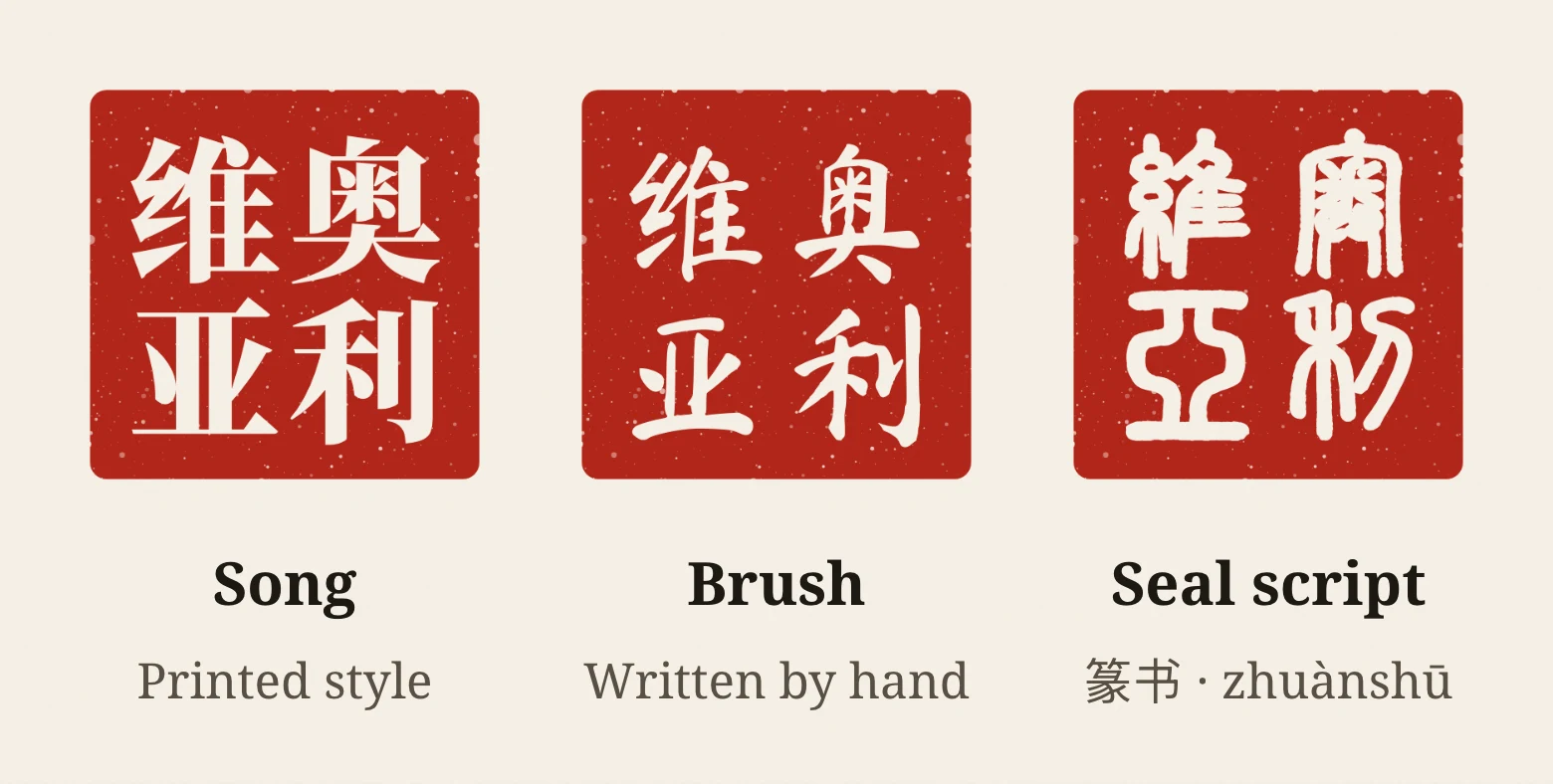
The characters on a Chinese seal rarely look like the Chinese you see on a menu or a street sign. They are rounder and more even, and sometimes they are almost unrecognizable. That is because most seals are carved in seal script, a style of writing that was already old two thousand years ago. Even the Chinese word for seal carving, 篆刻 (zhuànkè), means “seal-script carving.”
Large seal and small seal
Seal script (篆书, zhuànshū) covers the forms of Chinese writing in use before clerical script, the flatter and more angular style that became standard in the Han dynasty. It grew out of the writing cast into Zhou-dynasty bronzes. Two terms are used to divide it up.
Large seal script (大篆, dàzhuàn) is a loose label for the older, pre-Qin forms, such as the inscriptions on Zhou bronze vessels. It covers so much ground that modern scholars tend to avoid the term.
Small seal script (小篆, xiǎozhuàn) is the form that developed in the state of Qin during the Eastern Zhou. After the Qin unified China in 221 BCE, it became the official script of the whole empire, and the forms used in other states were dropped. Tradition credits the Qin chancellor Li Si (李斯, Lǐ Sī) with standardizing it and with compiling a character primer, the Cangjie pian, said to have held about 3,300 characters. Some modern scholars question how sudden and complete the Qin unification of writing really was, so it is fair to say the script took shape over time.
When people say “seal script” without saying which kind, they usually mean small seal script. Its strokes are even in thickness, with smooth curves and balanced, symmetrical shapes. The Getty Art and Architecture Thesaurus, in its Taiwanese edition, describes it as having “round, neat, and well-balanced strokes and structures.”
The Shuowen Jiezi: the seal carver’s dictionary
Our best record of small seal script comes from a dictionary. The Shuowen Jiezi (说文解字, Shuōwén Jiězì) was compiled by the Han scholar Xu Shen (许慎, Xǔ Shèn). He finished it in 100 CE, and it was presented to the throne in 121. Its 9,353 entries give each character in small seal form, along with 1,163 variant forms, and arrange them under 540 section headers, the ancestors of today’s radicals.
Because it explains how each character is built, the Shuowen became the standard reference for anyone writing or carving seal script. Seal carvers still check their characters against it, and some modern seal-script fonts are based on it.
Why seals still use seal script
By the Han dynasty, everyday writing had moved on to clerical script, but seal script was still widely used for seals and decorative engraving. Seals kept it, for several reasons:
- Tradition. Seal carvers have long taken ancient seals, especially those of the Qin and Han, as their models. Using the old script keeps a seal in conversation with that past.
- Shape. Seal-script lines are even and flexible. A carver can stretch, compress and bend them to fill a square or circle without the lines looking forced. Modern characters, with their hooks and strokes of varying thickness, tend to be harder to pack evenly into a small square.
- Formality. An archaic script gives a seal a sense of age and seriousness, the way Roman capitals do on a monument.
Seals aren’t limited to seal script. Many modern seals, and some historical ones, use clerical, regular or other scripts. But seal script is still the default for traditional seal carving.
How readable is it?
Not very, for most people. Some characters keep a clear family resemblance to their modern forms. Others look so different that a fluent reader of Chinese would need a dictionary. Carvers also have room to adapt shapes to the seal face, which makes reading harder still. In its description of seal engraving, UNESCO notes that the characters are complex and that fewer people can read them.
This is one reason seals are often shown with the name in modern characters alongside. If you are having a seal carved, it is reasonable to ask the carver to confirm which characters are used and how they are written.
Traditional and simplified characters
Simplified Chinese characters were introduced in mainland China in the 1950s. Seal script is about two thousand years older than that, and its structure matches the traditional forms of characters, since those forms grew out of it. Most of the characters that were simplified have no seal-script version of their new, simplified shape.
So a name written in simplified characters is normally converted back to traditional forms before it is carved. A few simplified characters happen to match older forms that were already in use, but in general, if your Chinese name is in simplified characters, expect your seal to show the traditional version.
Seal script in Chop1’s studio
Chop1’s free online studio offers three typefaces for a digital seal: Song, brush and seal script. The seal-script option uses Chong Xi Small Seal (崇羲篆體), a font from Academia Sinica in Taiwan whose small-seal forms are based on the Shuowen Jiezi. It is released under a Creative Commons Attribution-NoDerivatives license (CC BY-ND 3.0 TW). Simplified characters are shown in their traditional seal forms. Once you have a design you like, a custom seal can be carved from it in Shoushan stone from US$299 including express shipping, or made in another of the four famous stones, crystal, jade or gold for a quoted price.
Questions
Why are Chinese seals written in seal script?
Mostly by tradition. Seal script was still widely used for seals in the Han dynasty, after everyday writing had moved on. Seal carvers have modeled their work on ancient seals ever since, and the script’s even, flexible lines fit neatly into a square or round seal face.
Can Chinese people read seal script?
Many can’t read it fluently. Some characters look close to their modern forms, but many look very different, and UNESCO notes that fewer people can read the complex characters on seals. Calligraphers and seal carvers learn it, often with the help of dictionaries such as the Shuowen Jiezi.
Is seal script traditional or simplified Chinese?
Neither, strictly, because it is about two thousand years older than both. But its structure matches traditional characters, so a name written in simplified characters is normally converted to traditional forms before it is carved in seal script.
Who invented small seal script?
No single person did. It grew out of the writing of the state of Qin. Tradition credits Li Si, chancellor to the First Emperor, with standardizing it after 221 BCE, though modern scholars question how sudden and complete that standardization was.