
Yin vs Yang Seals: Baiwen and Zhuwen Explained
Short answer: A yin seal, or baiwen 白文 (“white characters”), has its characters cut into the stone, so they print white inside a block of red. A yang seal, or zhuwen 朱文 (“red characters”), has its characters left standing in relief, so they print as red lines on bare paper. Neither is more correct; many artists keep one of each and use them as a pair.
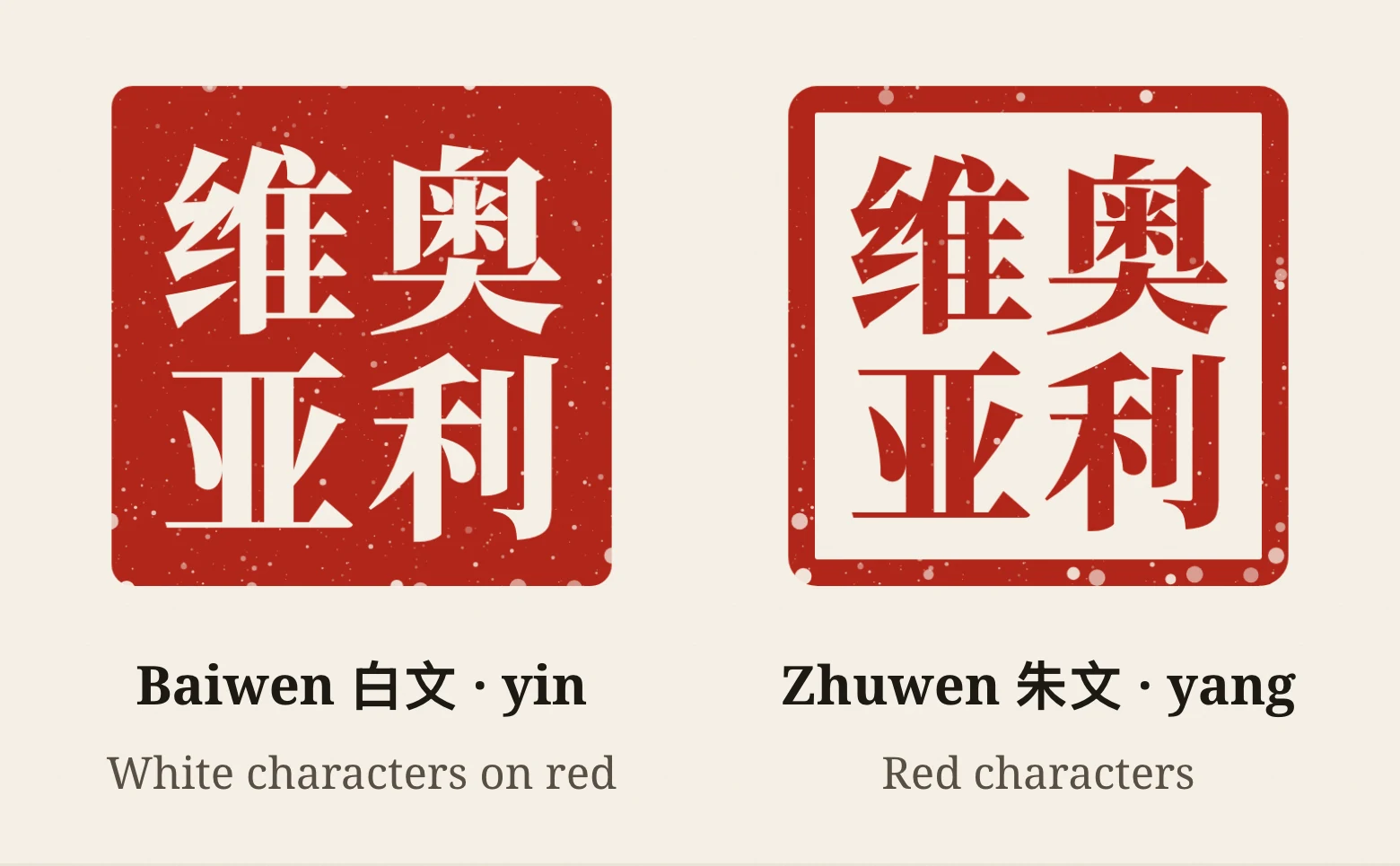
Look closely at the red marks on a Chinese painting and you will see two kinds. Some are solid red squares with the characters showing through in white. Others are red characters standing on bare paper, usually inside a thin red frame. These are the two basic types of Chinese seal, and almost every seal you will meet is one, the other or a mix of both.
The two types at a glance
| Baiwen 白文 (báiwén) | Zhuwen 朱文 (zhūwén) | |
|---|---|---|
| Literal meaning | “white text” | “vermilion text” |
| Also called | yin seal, intaglio | yang seal, relief |
| How it is carved | characters cut into the face | background cut away, characters left standing |
| On paper | white characters on a red ground | red characters on white paper |
| Overall effect | solid, weighty | light, linear |
The yin and yang names come from the carving terms 阴刻 (yīnkè), cutting into a surface, and 阳刻 (yángkè), cutting away around a raised design. They have nothing to do with fortune or with which seal is “male” or “female.” They simply describe whether the characters sink into the stone or stand up from it.
Where the two styles come from
White characters and sealing clay
Most early official seals, including those of the Qin and Han dynasties, were carved as white-character seals. They were not stamped in ink at first. Officials pressed them into small lumps of clay (封泥, fēngní) that sealed bundles of documents written on bamboo or wood. In soft clay, characters cut into the seal come out raised, which made them easy to read.
Red characters for paper
As paper replaced bamboo and wood, seals were inked with cinnabar paste and stamped directly on the page. Official seals changed with the new medium. A study of Chinese official seals by the historian Kataoka Kazutada of the University of Tsukuba found that a system of relief, red-character official seals began in the Sui and Tang dynasties. By the Song dynasty it had replaced the old white-character system, and it remained the basic form of official seals until the Qing.
Artists keep both
Personal seals never settled on one style. Scholars and seal carvers used both, and later carvers often took Han official seals as their model for white-character work. Some seals mix the two, carving some characters in relief and others in intaglio. This style is called 朱白相间印 (zhūbái xiāngjiān yìn).
How each looks on paper
Baiwen: a block of red
A white-character seal puts a lot of red on the page. The outline of the seal face sets the shape of the mark, and the characters read as white channels running through it. The texture of the stone, small nicks along the edge and the grain of the paper all show in that red field, which is part of the charm. Baiwen holds up well at small sizes and on busy pages, because the solid red catches the eye.
It needs firm, even pressure so the red prints as one solid area. One Taiwanese calligraphy guide from National Ilan University advises pressing white-character seals and large seals harder. Too much paste can fill the fine white lines, so ink the seal with light taps rather than one heavy press.
Zhuwen: red lines on paper
A red-character seal leaves most of the square as bare paper. The strokes, and usually a border, print as red lines. The effect is lighter and more open, and it suits fine handwriting, pale washes and lots of empty space. Because the raised lines are thin, the same guide advises a lighter touch for red-character seals. On rough or textured paper, thin lines may print broken.
Pairs and conventions
You can always use a single seal. Many calligraphers stamp just one name seal below their signature. When two are used, a few conventions are widely repeated:
- One of each. Inkston’s guide says it is common practice to keep two name seals, one yin and one yang, and that a yin and yang pair looks better than two of the same kind.
- Matched size, white above red. The National Ilan University guide describes a more formal arrangement: two seals of the same size, one white-character and one red-character, stamped one above the other with the white seal on top.
- Name and style name. Often one seal carries the full name and the other a courtesy name or art name. A tendency to cut personal names in white characters and art names in red is often described, but plenty of artists do the opposite.
- Match the picture. Inkston suggests yang seals for works in lighter colors and yin seals for heavier ones, so the seal sits in balance with the work.
These are habits of taste, not rules. A white-character seal next to a red-character seal of the same size simply tends to look balanced.
Choosing a style for your own name seal
If you are getting one seal, think about where it will be used:
- For a bold, formal mark, such as on greeting cards, bookplates or busy pages, baiwen gives a strong red square that is easy to see.
- For a lighter mark beside handwriting, a sketch or a pale watercolor, zhuwen sits more quietly on the page.
- For a long or complex name, remember that every stroke has to fit in a small square. In zhuwen, all those strokes print red and can look dense. In baiwen, they become white channels through the red. Compare both before you decide.
- For flexibility, make a pair: one of each, the same size, so you can use either alone or both together.
How the mark will be stamped matters too. Our guides to where to stamp a seal and seal paste cover placement, pressure and ink.
Trying both styles
Chop1’s free online studio lets you switch the same name between white-character (baiwen) and red-character (zhuwen) carving, in Song, brush or seal script, on a square or round seal, and download the result as a PNG. If you want the seal in your hand, a custom stone seal can be carved from any of the four famous seal stones or made in crystal, jade or gold. Shoushan stone starts at US$299 including express shipping; other materials are quoted.
Questions
Is baiwen yin or yang?
Baiwen is yin. The characters are cut into the seal face (intaglio, 阴刻 yīnkè), so they print white on a red ground. Zhuwen is yang: the characters stand in relief (阳刻 yángkè) and print red on white.
Which is more traditional, baiwen or zhuwen?
Both are traditional. Early official seals were mostly white-character seals pressed into clay. From the Sui and Tang dynasties, official seals moved to red characters. Artists and scholars have used both styles for centuries.
Should a personal name seal be baiwen or zhuwen?
Either is fine. Baiwen gives a bold, solid red mark that holds its own on a busy page. Zhuwen gives a lighter, more open mark that sits quietly beside handwriting. If you can, try both and keep the one you like, or use one of each as a pair.
What is a zhubai seal?
It is a mixed seal, 朱白相间印 (zhūbái xiāngjiān yìn), in which some characters are carved in relief and others in intaglio, so the impression combines red and white characters in one square.
Sources
- Seal (East Asia) (Wikipedia)
- The Official Seal Systems in the Period of the Five Dynasties and Song Dynasty, KAKENHI project 19520597 (Kataoka Kazutada, University of Tsukuba)
- Inshō 印章 (JAANUS, Japanese Architecture and Art Net Users System)
- 金石書畫與陶瓷工藝 (National Ilan University)
- Technical Aspects of Painting (A Visual Sourcebook of Chinese Civilization, University of Washington)
- Chinese Seals guide (Inkston)