
Where to Put a Seal on a Chinese Painting or Calligraphy
Short answer: On a Chinese painting or piece of calligraphy, the artist’s name seal goes just below the signature, or beside it if there is no room, either alone or as a matched pair. An optional head seal (引首章) can sit near the top right where the text begins, and a corner seal (压角章) can steady a lower corner. Collectors add their own seals later, usually in the margins, and there is no fixed number.
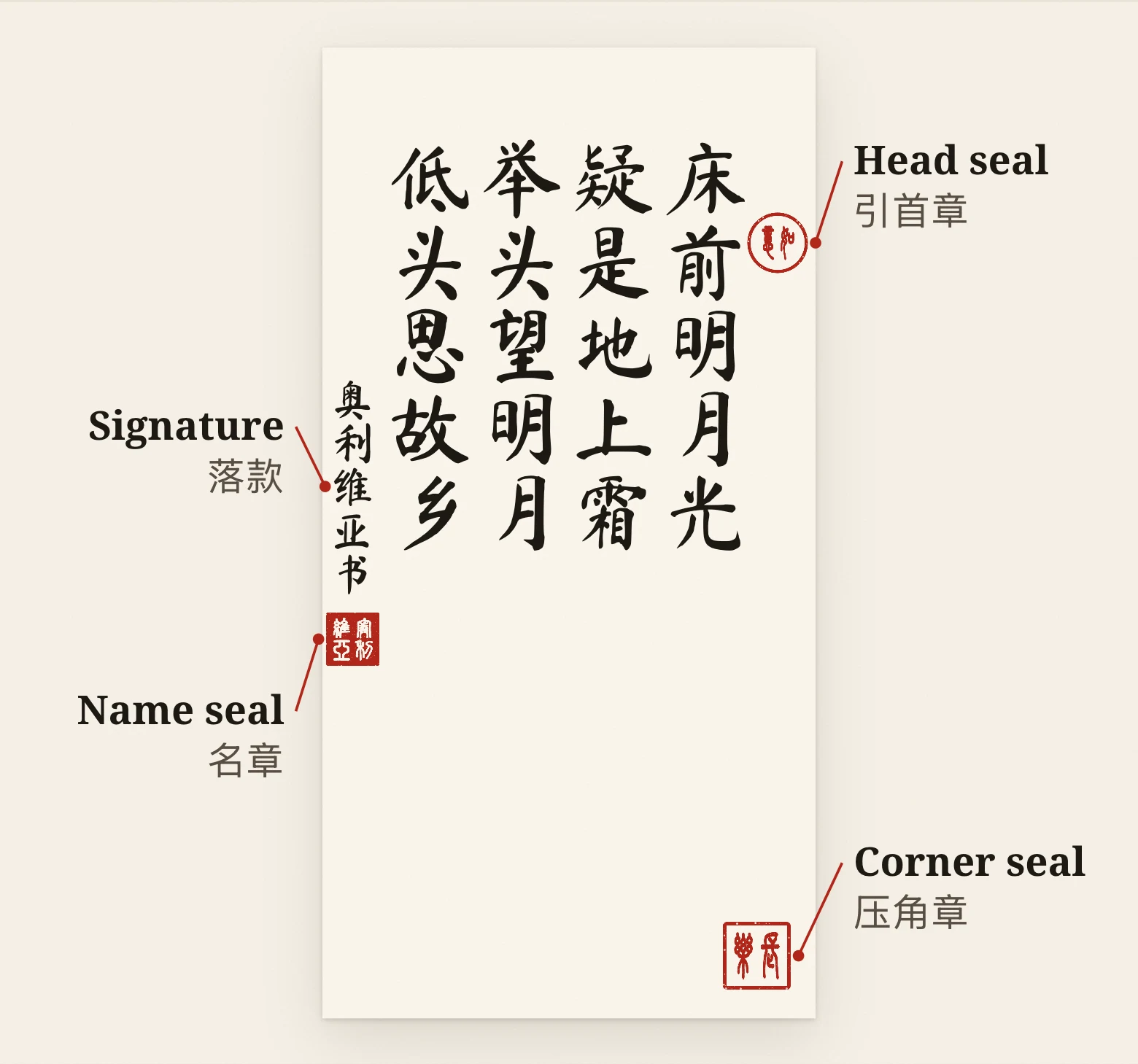
A seal finishes a piece of Chinese painting or calligraphy the way a signature finishes a letter. It also does something a signature can’t: a small block of red can balance a composition, fill an awkward gap or draw the eye back to the start of a line. The guidelines below come from Chinese calligraphy teaching. They are conventions of good taste rather than strict rules, and artists bend them all the time.
The name seal: under or beside the signature
The most important seal is the artist’s name seal (姓名章, xìngmíngzhāng, or simply 名章, míngzhāng). It goes with the signature and inscription, the 落款 (luòkuǎn), usually directly below the last character of the signature. If the signature runs to the bottom of the paper and there is no room below, put the seal just to its left.
Using one seal is completely normal. A calligraphy guide from National Ilan University in Taiwan notes that some writers use a single red-character seal. The more formal arrangement is a matched pair of the same size, one white-character and one red-character, stamped one above the other with the white seal on top. Often one carries the full name and the other a courtesy name or art name. Leave a little space between them, and keep both in scale with the signature, so the seals don’t overpower the writing. For more on the two carving styles, see yin vs yang seals.
Leisure seals: head, edge, corner and waist
Seals that don’t carry the artist’s personal name are known as leisure seals (闲章, xiánzhāng). They may carry a studio name, a motto, an auspicious phrase or a line of poetry. On a work, they are named for where they sit.
Head seal (引首章)
The head seal (引首章, yǐnshǒuzhāng) marks the beginning of the text. The Ilan guide places it on the right edge, about a quarter of the way down, roughly level with the space between the first and second characters, and not too low. Its shape is free, which is why it is also called a “follow-the-shape” seal (随形章, suíxíngzhāng), though some people feel an upright rectangle looks steadiest. Studio names and short phrases are typical texts.
Edge seal
An edge seal (栏边章, lánbiānzhāng) is stamped along one side of a work to tie the composition together on that side.
Corner seal (压角章)
A corner seal (压角章, yājiǎozhāng) sits in a corner, usually a lower one, and has to relate to both edges of that corner. Its job is to steady the composition and fill an empty corner. Inkston’s guide notes that a corner seal at the lower left is often used to answer a head seal at the upper right. If the signature and name seals are already on the left, the corner seal can go at the lower right instead.
Waist seal
On a tall, narrow hanging scroll, a single head seal can leave the middle looking empty. Some calligraphers add a smaller waist seal (腰章, yāozhāng) on the right, about a third of the way up from the bottom. It should be smaller than both the head seal and the name seal.
Don’t overdo it
There is no correct number of seals. A seal that balances a work helps it. Three or four seals on a small piece can look like clutter. When in doubt, use just the name seal.
Collectors’ seals
Seals are also added after a work leaves the artist’s hands. Collectors’ seals (鉴藏印, jiàncángyìn, also called 收藏印, shōucángyìn) record that someone owned or examined a work, as the Hong Kong Museum of Art’s guide to seals explains. They are usually stamped near the outer edges and margins, though on some famous paintings they spread across the image itself. For historians they are a record of a work’s owners and viewers, but seals can be copied, so they are never proof of authenticity on their own.
The most famous stamper of all was the Qianlong Emperor (r. 1735–1796). Robert Mowry, curator emeritus of Chinese art at the Harvard Art Museums, has noted that Qianlong impressed more seals on paintings in the imperial collection than any other emperor. Many of them are cataloguing seals, marking that a work had been entered in the imperial catalogue.
If you own a work and want to add your own seal, it is considerate to keep it small and in a margin, away from the image and the artist’s writing.
Letters, books, cards and journals
The same logic works on everyday paper:
- Letters and cards. Stamp your name seal right after your signature, just as you would on calligraphy. On a folded card, stamp before you write a long message, so a slip doesn’t spoil the card.
- Books. Stamp an ownership seal on the title page or flyleaf, in a corner or margin, away from printed text. Put a sheet of scrap paper behind the page so paste doesn’t transfer.
- Journals and sketchbooks. A small seal at the bottom corner of a finished page, or beside the date, works well. Thin paper can show oil from seal paste on the reverse, so test first.
- Glossy or coated paper. Oil-based seal paste dries slowly on paper that doesn’t absorb it and can smudge. Let it dry flat and uncovered.
How to get a clean impression
- Prepare the paste. Stir it with a spatula so the oil and pigment are evenly mixed. Our seal paste guide explains how.
- Ink lightly. Tap the seal face onto the paste several times rather than pressing hard once. Check that the whole face is evenly red. Too much paste fills fine lines and blurs edges.
- Pad the paper. Stamp on a firm but slightly cushioned surface, such as a few sheets of paper, a felt pad or a seal mat. A bare hard table can leave gaps in the print, and a thick soft pad can blur it.
- Check the orientation. Before stamping, make sure the seal is the right way up. A test on scrap paper is the easiest check.
- Press evenly. Press straight down with steady, even pressure. The Ilan guide advises a light touch for red-character seals, whose lines are fine, and firmer pressure for white-character seals and large seals so the red prints solid.
- Lift straight up. Lift the seal off cleanly and quickly without sliding it, then wipe the face with soft paper.
- Let it dry. Leave the impression uncovered until the paste has set.
Stamping your own name
If you don’t yet have a seal, Chop1’s free online studio carves your name as a digital seal you can download as a PNG, which is handy for digital cards and documents. For paper, a custom seal can be carved from any of the four famous seal stones or made in crystal, jade or gold, with a 3 × 3 cm face. Reservations are open now, and ordering opens in mid-November 2026.
Questions
Where does the seal go on Chinese calligraphy?
Directly below the signature, or just to its left if there is no room below. If you use two seals, stack them under the signature, ideally the same size, with a small gap between them. A head seal at the upper right and a corner seal at a lower corner are optional extras.
How many seals should a painting have?
There is no fixed number. Many works carry a single name seal. Others add a pair of name seals, a head seal or a corner seal. The aim is balance: seals should support the composition, not crowd it.
What is a leisure seal?
A leisure seal (闲章, xiánzhāng) carries a phrase, motto, line of poetry or studio name rather than the artist’s personal name. Head seals, edge seals, corner seals and waist seals are usually leisure seals.
How do I get a clean seal impression?
Stir the paste, then tap the seal onto it lightly several times until the face is evenly coated. Stamp on a slightly cushioned surface, press straight down with even pressure, and lift straight up. Use a lighter touch for fine red-character seals and more pressure for white-character and large seals.
Sources
- 金石書畫與陶瓷工藝 (National Ilan University)
- Chinese Seals guide (Inkston)
- Vermillion Impressions: Chinese Painting and Calligraphy Seals (Hong Kong Museum of Art)
- Technical Aspects of Painting (A Visual Sourcebook of Chinese Civilization, University of Washington)
- Text trumps art (Language Log, University of Pennsylvania)
- 印泥的使用与保养 (Sohu)