
Chinese Bamboo Carving (竹刻): History, Techniques and Care
Short answer: Chinese bamboo carving (竹刻, zhúkè) is the art of cutting pictures, poems and calligraphy into bamboo stems and roots with a knife. It became a scholar's art in the Ming dynasty, centred on Jiading near Shanghai and on Nanjing, and produced brush pots, wrist rests and incense holders for the writing desk. Its best-known technique, liuqing, cuts the design from the bamboo's thin outer skin.
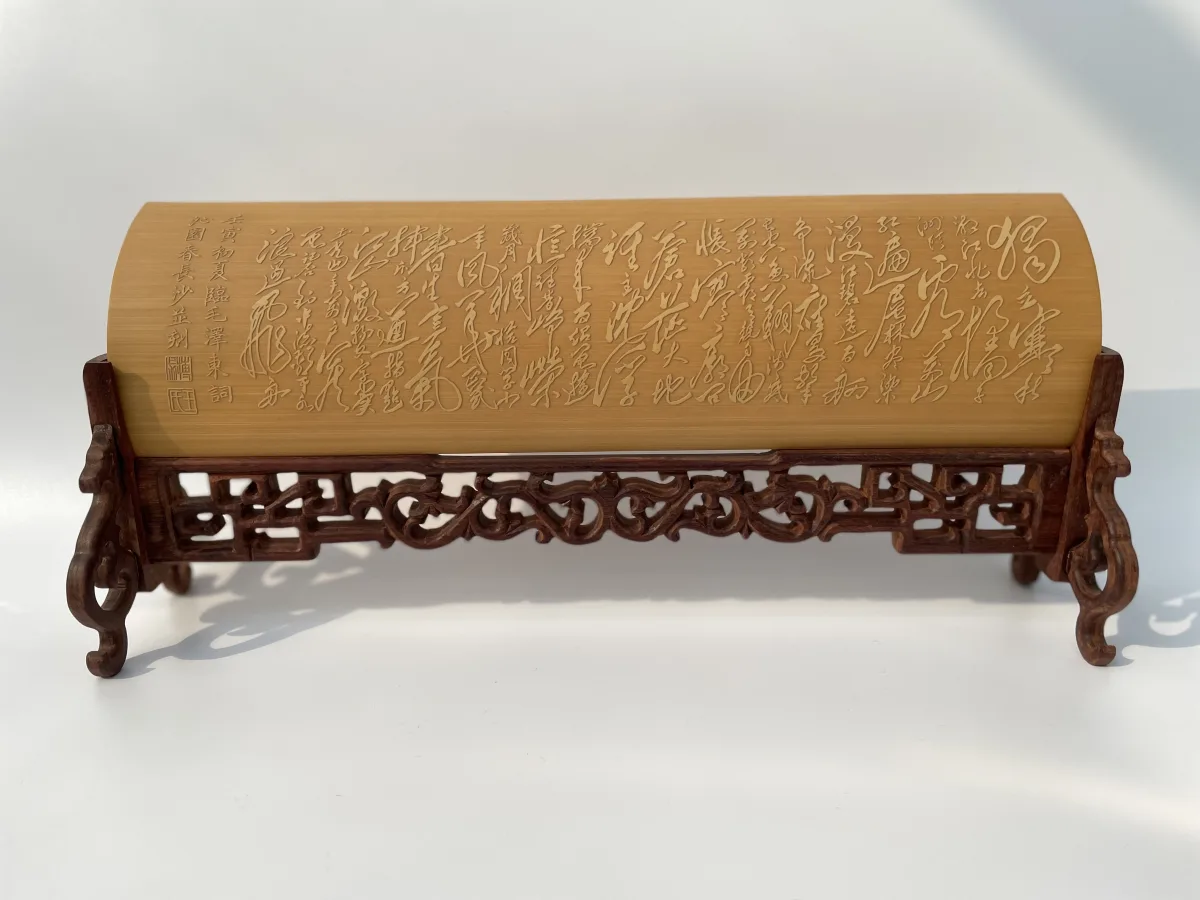
Chinese bamboo carving (竹刻, zhúkè) is the art of cutting pictures, poems and calligraphy into bamboo with a knife. It became a scholar’s art in the Ming dynasty, led by carvers in Jiading, near Shanghai, and in Nanjing. Most classic pieces were made for the writing desk: brush pots, wrist rests, incense holders and small screens.
Why bamboo
Bamboo’s toughness was long likened to a scholar’s upright character, and the V&A notes that bamboo is a symbol of righteousness. It is also built in layers, and carvers use each one:
- The skin (竹青, zhúqīng, or poetically 青筠, qīngyún): a very thin, smooth, glossy outer layer.
- The flesh (竹肌, zhújī): the fibrous wall beneath it.
- The inner layer (竹簧, zhúhuáng): a thin layer lining the hollow of the stem.
Changzhou carvers prefer to cut it in deep winter, when it grows slowly and is dense. They boil the stems for about two hours to keep insects out and make later cracking less likely, then dry them upright in a cool, airy place, out of the sun, for about two years.
Time keeps working after the carving is finished. The treated skin turns a pale creamy yellow that one Chinese account compares to ivory. The flesh starts a pale ochre and darkens over the years, so the contrast between the two grows. A Fujian heritage listing compares old pieces to ripening cherries and polished amber.
A scholar’s art: Ming to modern
A Tang dynasty (618–907) bamboo flute in the Shōsōin treasure house in Nara, Japan, is often cited as the earliest surviving carving in bamboo skin. But it was in the Ming dynasty (1368–1644) that bamboo carving broke away from everyday craft, took up designs by literati painters and became an art in its own right.
Jiading. Jiading (嘉定, Jiādìng), now a district of Shanghai, was the first great centre. China’s heritage listing credits Zhu He (朱鹤, Zhū Hè), known as Songlin (松邻), with founding the tradition in the Zhengde and Jiajing reigns (1506–1566). He brought painting and calligraphy into carving and developed a “deep carving” style of openwork and deeply cut relief. His son Zhu Ying (朱缨, Zhū Yīng), known as Xiaosong (小松), and grandson Zhu Zhizheng (朱稚征, Zhū Zhìzhēng), known as Sansong (三松), carried it on, and the family is remembered as the “three Zhus” (三朱). By Zhu Zhizheng’s time, in the late 16th and early 17th centuries, Jiading carving had all its techniques in place, according to the Shanghai Museum.
Nanjing. The other great name is Pu Zhongqian (濮仲谦, Pú Zhòngqiān) of Nanjing, also called Jinling (金陵, Jīnlíng), active in the early 17th century. He was famous for doing as little as possible. The writer Zhang Dai (张岱, Zhāng Dài) recorded that Pu liked best to work on gnarled bamboo roots and prided himself on not using knife or axe (不事刀斧): a little scraping and polishing, and the piece sold for a high price. In the Qing dynasty, Jin Yuanyu’s Records of Bamboo Carvers (竹人录, Zhúrén lù) named two schools, one founded by Pu in Jinling and one by Zhu Songlin in Jiading. Some modern scholars, starting with Wang Shixiang, have questioned whether Nanjing really had a school of its own.
Zhang Xihuang and liuqing. Zhang Xihuang (张希黄, Zhāng Xīhuáng) is the name most closely tied to liuqing, carving pictures in the bamboo skin. Wuxi’s heritage listing credits him with creating liuqing landscapes, and Changzhou’s carvers see themselves as his heirs. His dates are uncertain: the Metropolitan Museum of Art dates its brush holder by him to the early 17th century, but a Shanghai Museum specialist places him in the Kangxi to Qianlong era (1662–1795).
The Qing and after. Jiading reached its height under the Qing (1644–1911). In the Kangxi era Wu Zhifan (吴之璠) developed low relief on a thinly cut ground, and the three Feng brothers excelled at carving in the round. In the 18th century the painter Zhou Hao (周颢, 1685–1773) became the school’s leading carver, and the Qianlong emperor had his poems carved on brush pots by Jiading carvers. By the late Qing, Changzhou’s liuqing carving was considered the best in China. In the 20th century the Shanghai carver Jin Xiya (金西厓, 1890–1979), whom the Met calls the finest bamboo artist active in 20th-century China, carried the old techniques forward.
Today. In 2006 Jiading bamboo carving was entered on China’s first national list of intangible cultural heritage, along with Baoqing bamboo carving from Hunan. The 2008 list added Changzhou and Wuxi liuqing carving and Huangyan fanhuang carving from Zhejiang, and Putian liuqing carving from Fujian followed in 2014. Several listings warn that the slow, poorly paid craft is struggling.
Techniques
Jiading’s listing counts more than ten techniques. The main ones:
- Liuqing (留青, liúqīng, “keeping the green”). The design is cut from the skin and the rest of the skin is pared away, leaving the picture in very low relief against the flesh. In Changzhou the work has four stages: shaping the bamboo, drawing the design, cutting round the edges and paring away the ground. For a painting, the carver keeps all, most, some or none of the skin in each area to suggest darker or paler ink. A fine piece can take months.
- Shallow engraving (浅刻, qiǎnkè). Lines incised into the surface, much like brushstrokes.
- Relief (浮雕, fúdiāo). Low and high relief, including Wu Zhifan’s low relief on a thin ground (薄地阳文, bódì yángwén).
- Deep carving and openwork (深刻, shēnkè; 透雕, tòudiāo). Cutting deep into the wall, and right through it, to build scenes in layers. This was the Zhu family’s speciality.
- Root carving (竹根圆雕, zhúgēn yuándiāo). The knotty root is carved in the round into figures, animals and landscapes.
- Fanhuang (翻簧, fānhuáng, also called 贴簧, tiēhuáng). The thin inner layer is peeled off, boiled, flattened and dried, then glued onto a wooden or bamboo body, polished and carved. The surface has an ivory-like sheen. Hunan’s listing credits a Kangxi-era carver with developing it; in Huangyan, Zhejiang, the craft dates from 1870.
Objects for the writing desk
Jiading’s listing names brush pots, incense holders, wrist rests, table screens and pairs of couplet boards cut from bamboo tubes and slats, as well as figures carved from roots.
- Brush pots (笔筒, bǐtǒng) are cut from a single section of stem, which gives the carver a scene that runs all the way round.
- Wrist rests (臂搁, bìgē) solved a practical problem. Chinese was written with a brush in vertical columns, from right to left. As the V&A explains, the ink did not dry quickly enough as the writer moved on to the next column, and a wrist rest kept the hand from smearing the finished lines. The Palace Museum notes that they are mentioned in Song dynasty texts. Most are bamboo, partly because a split stem already has a gentle curve.
- Incense holders (香筒, xiāngtǒng) are tall tubes, often carved in openwork. The Met notes that the pierced decoration lets out the fragrance of the incense sticks burning inside.
- Fan ribs (扇骨, shàngǔ). Pu Zhongqian’s polished, shallow-cut fan ribs were fashionable in the late Ming, and liuqing ribs appeared in the mid-Qing.
Signed like a painting
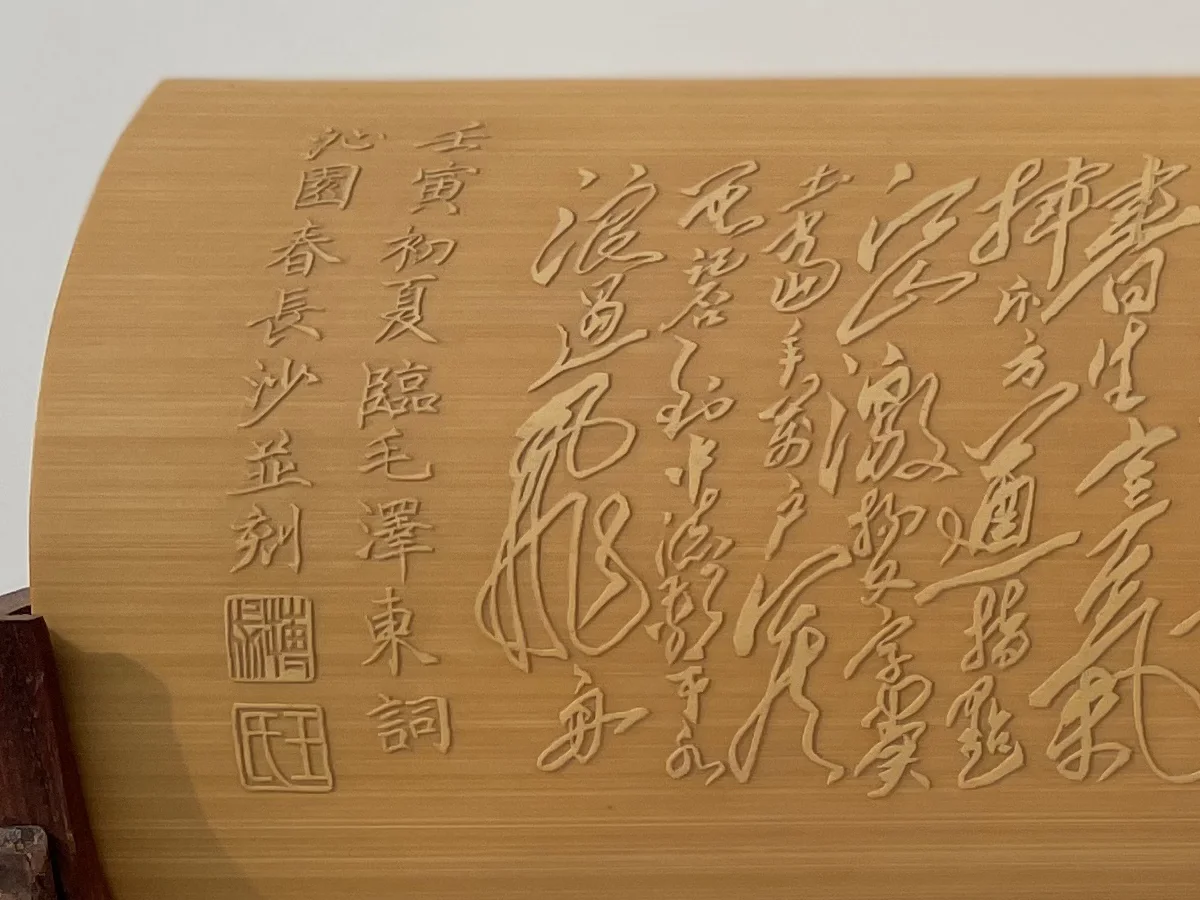
A fine bamboo carving is signed the way a painting is. Jiading’s listing says its carvers “used the knife in place of the brush” (以刀代笔) and combined calligraphy, painting, poetry and the seal in one object. Many pieces carry a title, an inscription, a date, the carver’s name or art name and one or two small carved seals.
Signatures mattered early. Zhang Dai wrote that once Pu Zhongqian’s signature (款, kuǎn) was on an object, its price shot up. The Palace Museum’s brush pot by Pu is signed 仲谦手治, “made by Zhongqian’s own hand”. Zhu Zhizheng usually signed “Sansong” in running script, but a brush pot in the Shanghai Museum carries his full name and the date 1615 in seal script. Zhang Xihuang’s brush holder at the Met has both a signature and a seal.
Dates often follow the 60-year cycle rather than a numbered year. A 1921 wrist rest in the V&A is inscribed “Painted by Difan, cut by Xiya in the 10th month of the xin yu year”: the painter Yu Ming (Difan) drew the design, Jin Xiya carved it, and both names went on the bamboo. If you have stamped a painting, the logic will feel familiar; see where to stamp a seal.
Caring for a bamboo carving
Little care advice exists for bamboo carvings as such, but the Canadian Conservation Institute’s advice for basketry, made from similar plant materials, covers the main risks.
- Keep the air steady. Below about 40% relative humidity, plant fibres dry out and turn brittle; above about 65%, mould can grow. Swings in humidity make the fibres swell and shrink, which is how cracks start.
- Keep it out of the sun and away from heat. Light damage builds up and cannot be reversed, and heat speeds up embrittlement; CCI recommends staying below 25 °C. Avoid sunny windowsills, radiators and heating vents.
- Dust gently. Use a soft brush. Never soak bamboo or immerse it in water.
- Handle with care. Pick a piece up with both hands and support its body, not thin edges or pierced sections.
The pieces shown here
All three pieces are by the carver who makes Chop1’s seals.
- The wrist rest at the top carries a cursive copy of the poem 沁園春·長沙 (Qinyuanchun: Changsha) across its gently curved face. A short inscription at the end says the carver copied the poem and carved it in early summer of the renyin year, 2022, followed by two small square seals. It sits on a carved hardwood stand.
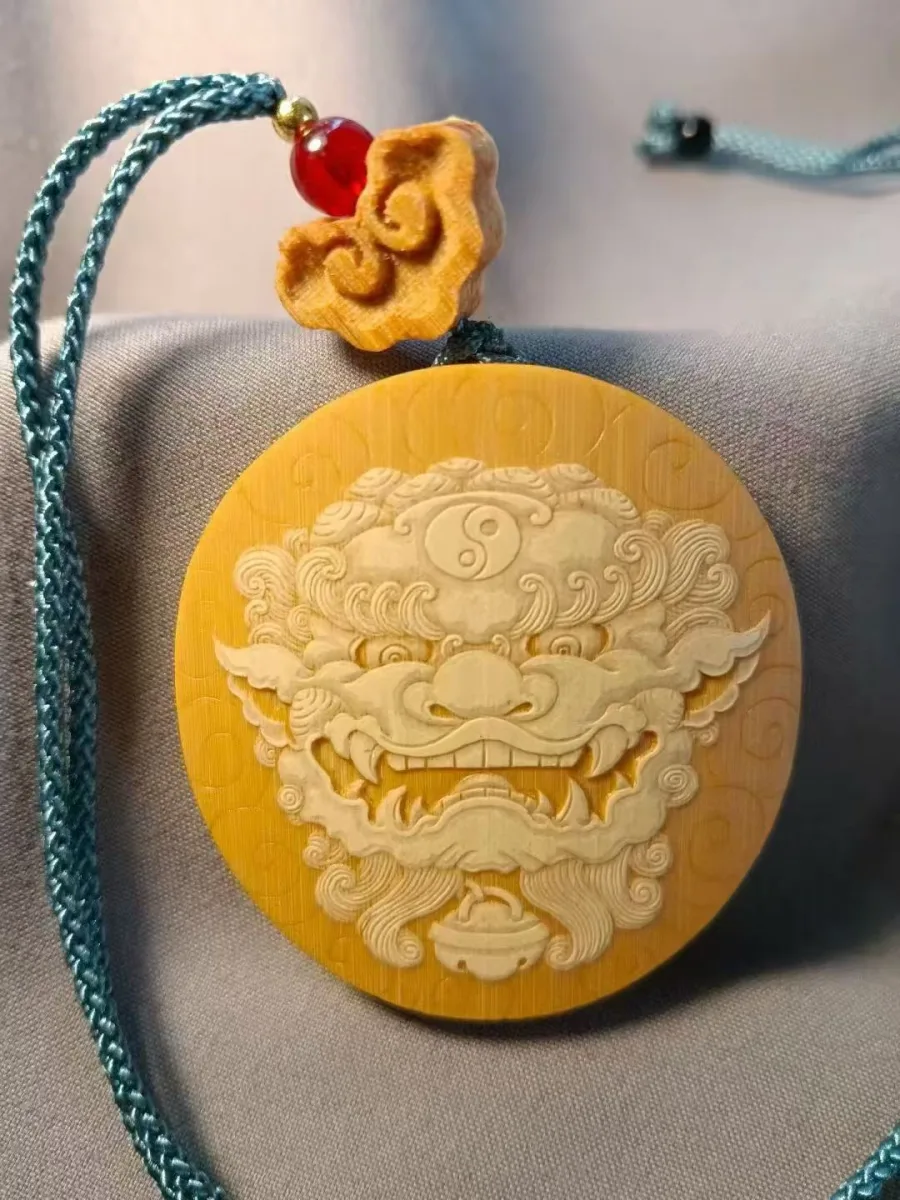
- The pendant is a round disc carved with a guardian lion’s face: a curling mane, a yin-yang symbol on its brow and a bell beneath its jaw, with faint cloud scrolls behind. It hangs on a teal cord with a red bead.
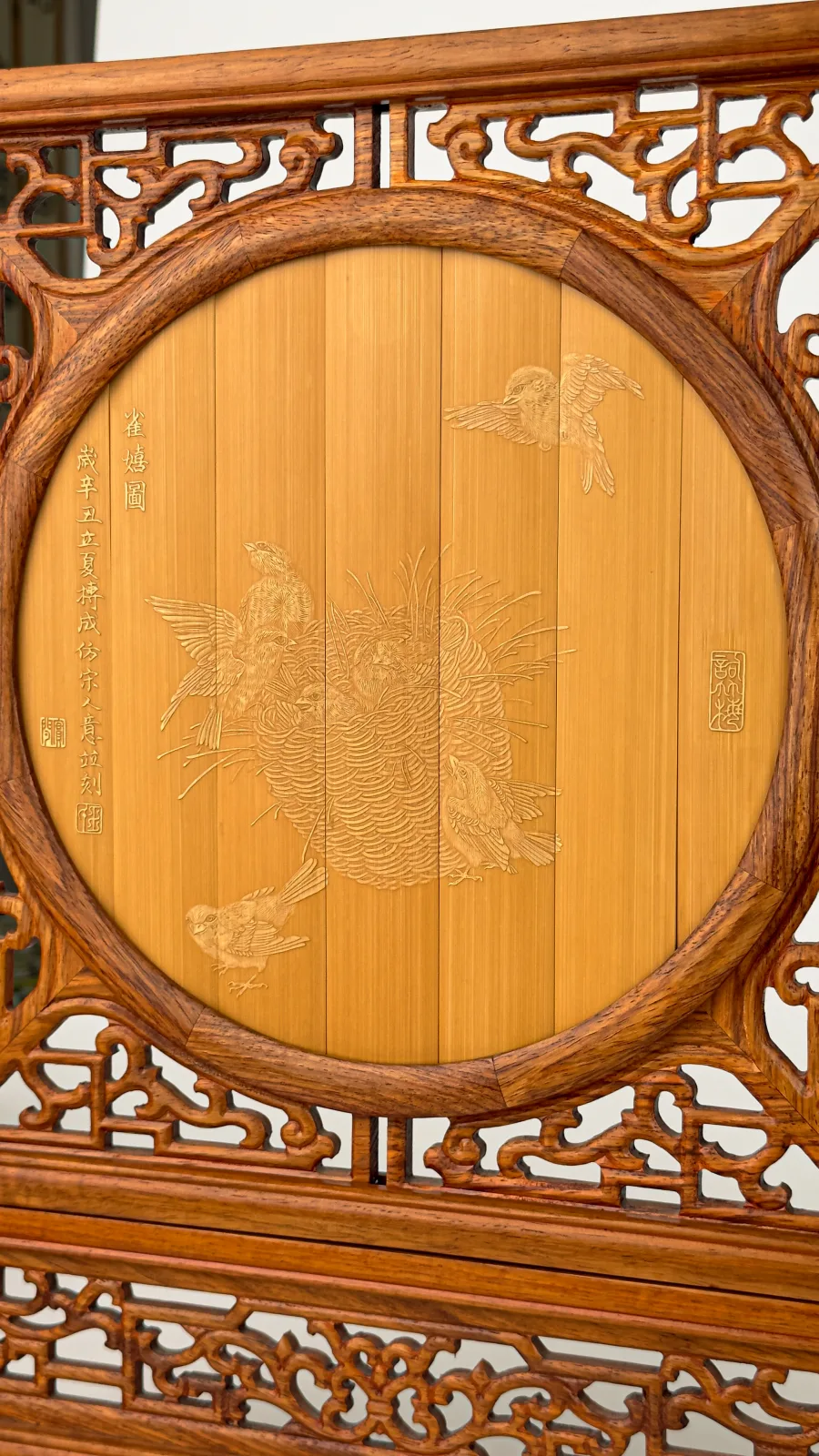
- The panel, 雀嬉圖 (Sparrows at Play), shows sparrows around a woven nest in long grass. It is made of several vertical boards and set into a carved hardwood screen. The inscription dates it to the start of summer in the xinchou year, 2021, and says it follows the manner of Song dynasty painters. Small carved seals sit on both sides of the picture.
Bamboo carving at Chop1
Chop1’s carver works in bamboo as well as stone, making wrist rests, pendants and panels like the ones above. If you would like a custom piece, such as a wrist rest carved with your name, a favourite poem or the design of your own seal, you can discuss it through the contact form. New to Chinese seals? Start with what is a Chinese chop, or try a name design in the free online seal studio.
Questions
What is liuqing bamboo carving?
Liuqing (留青, liúqīng, 'keeping the green') is a bamboo carving technique in which the design is cut from the thin outer skin of the bamboo and the rest of the skin is pared away, leaving the picture in very low relief against the fibrous flesh beneath. Over the years the skin mellows to a pale cream while the flesh darkens, so the contrast grows.
What is a bamboo wrist rest for?
A wrist rest (臂搁, bìgē) is a curved strip of bamboo laid on the desk while writing with a brush. Chinese was written in vertical columns from right to left, and the rest kept the writer's hand and arm off lines whose ink was still wet. Bamboo suited it because a split section of stem already has a gentle curve.
Who were the three Zhus of Jiading?
Three generations of one family who made Jiading, now part of Shanghai, the leading centre of Chinese bamboo carving: Zhu He (Songlin), who founded the tradition in the 16th century, his son Zhu Ying (Xiaosong) and his grandson Zhu Zhizheng (Sansong), active in the late 16th and early 17th centuries.
Is Chinese bamboo carving recognised as cultural heritage?
Yes. Jiading bamboo carving was entered on China's first national list of intangible cultural heritage in 2006. Changzhou and Wuxi liuqing carving and Huangyan fanhuang carving were added in 2008, and Putian liuqing carving in 2014.
How do I look after a bamboo carving?
Keep it out of direct sun, away from radiators and heating vents, and out of very dry or damp air, and avoid sudden changes in humidity, which can make bamboo crack. Dust it with a soft brush, never soak it in water, and pick it up with both hands.
Sources
- 竹刻(嘉定竹刻) (Jiading bamboo carving) – China Intangible Cultural Heritage Network
- 竹刻(常州留青竹刻) (Changzhou liuqing bamboo carving) – China Intangible Cultural Heritage Network
- Zeng Yan, 常州白氏留青竹刻 (The Bai family's liuqing bamboo carving in Changzhou), Sanlian Life Weekly – China Intangible Cultural Heritage Network
- 朱稚征竹雕松下高士笔筒 (Bamboo brush pot by Zhu Zhizheng) – Shanghai Museum
- 濮仲谦竹雕竹枝笔筒 (Bamboo brush pot by Pu Zhongqian) – Palace Museum
- Zhang Xihuang, Brush holder with “Ode to the Pavilion of the Inebriated Old Man” – The Metropolitan Museum of Art
- Wrist rest by Jin Xiya, carved bamboo, 1921 – Victoria and Albert Museum
- Care of Basketry (CCI Notes 6/2) – Canadian Conservation Institute